

Last updated October 30, 2026
 Water damage drying
 Fire & smoke cleanup
 Mold remediation
 Storm response
 Sewage cleanup
 Reconstruction
Free visual inspection and a written scope of work before any mitigation begins - photos, moisture readings, and drying logs go in your claim file
The scope we write is the scope we bill. Anything new gets shown to you, in writing, before we touch it.
Get your free estimateWater Damage Restoration Troubleshooting: Common Problems and How to Fix Them
A dehumidifier running in a closed room is not the same as a restoration drying system. One recirculates the same air. The other creates a controlled pressure differential that actively pulls moisture through building materials. That distinction explains why so many water damage jobs in Fullerton fail weeks or months after everyone thought the problem was solved. This guide—along with The Complete Guide to Damage Restoration in Fullerton—walks through the specific failure points we see on repeat, from false-dry cavities to musty smells that never quite go away, and what it actually takes to fix each one correctly.
Quick Answer
The most common water damage restoration problems are incomplete moisture extraction, hidden water in wall and floor cavities, equipment that runs without moving moisture, and premature reconstruction before drying is verified. Each has a specific fix: re-extraction, targeted cavity drying with systems like Injectidry, psychrometric monitoring to confirm real drying progress, and documented moisture readings before any drywall or flooring goes back in.
Restoration work we handle
Table of Contents
- The False-Dry Problem: When Surfaces Test Dry but Cavities Are Wet
- The Musty Smell That Won’t Go Away: What It Actually Means
- When a Second Extraction Pass Is Warranted
- Equipment Running but Moisture Readings Plateau: What’s Wrong
- Signs a Previous Restoration Was Incomplete
- Reading a Psychrometric Chart to Confirm Real Drying
- Equipment Placement Errors That Stall Every Job
- DIY Drying vs Professional Restoration: Where the Line Is
The False-Dry Problem: When Surfaces Test Dry but Cavities Are Wet
The single most expensive mistake in water damage restoration is closing up a wall because the surface reads dry. Moisture meters measure what they touch. A drywall face can read 8% while the stud cavity behind it holds 30% moisture content. In Fullerton’s climate, where summer temperatures regularly push past 90 degrees, surface evaporation happens fast. That speed tricks people into thinking the structure is dry when the inside of the wall is still saturated.
Here’s how false-dry happens. Water wicks into drywall, insulation, and framing. The surface dries first because it has direct airflow. The cavity behind it doesn’t. A technician using only a non-penetrating meter gets a surface reading, sees a low number, and signs off. Six months later, the homeowner notices bubbling paint, warped baseboards, or that musty smell that never quite left. By then, mold has established inside the cavity and the repair cost has multiplied.
The fix is non-negotiable: penetrating moisture readings in every affected wall and floor cavity before any reconstruction begins. A penetrating meter with pins or a radio-frequency scanner reads through the drywall into the stud bay. That’s the number that matters. We’ve walked into Fullerton homes where a previous crew left surface-dry walls that still held 25-35% moisture in the framing. The only correct fix at that point is reopening the wall, removing saturated insulation, and drying the cavity with targeted airflow or an Injectidry system before any new drywall goes up.
If you’re checking your own walls after a water event, a $40 surface meter from a hardware store won’t tell you what’s behind the gypsum. You need professional-grade penetrating instruments. That’s one reason IICRC-certified restoration work includes documented cavity readings at multiple depths, not a single surface pass.
The Musty Smell That Won’t Go Away: What It Actually Means
A musty odor after water damage is not a laundry problem. It’s microbial activity. When organic materials like drywall paper, wood framing, or carpet padding stay above 20% moisture content for more than 48-72 hours, mold spores already present in every home begin to colonize. The smell is the metabolic byproduct of that growth. It’s called microbial volatile organic compounds, or MVOCs.
The critical insight most homeowners miss: the smell means active biological growth inside a material, not just a lingering odor. Spraying air freshener, running an ozone machine, or painting over the area does nothing to the colony inside the wall cavity. The smell returns because the moisture is still there, feeding the growth.
What we’ve seen in Fullerton homes is the same pattern: a slow pipe leak behind a bathroom vanity, a dishwasher supply line dripping under the cabinet, or condensation from an uninsulated AC duct in a crawlspace. The water source stops, the surface dries, but the musty smell persists. When we open the wall, there’s visible mold colonization on the backside of the drywall and on the framing. That’s a mold remediation in Fullerton situation, not a cleaning task.
The fix follows a specific sequence. First, find and stop the moisture source. Second, remove any materials that are saturated beyond drying or already colonized. Third, dry the remaining structure to below 16% moisture content in wood and below 10% in drywall. Fourth, clean or remove any residual microbial growth. Fifth, verify with post-remediation moisture and air sampling before closing the wall. Skipping any step means the smell comes back.
When a Second Extraction Pass Is Warranted
Extraction is the unglamorous step that determines whether the rest of the job succeeds. The first pass with a truck-mounted or high-capacity portable extractor removes standing water. But water keeps wicking upward through carpet pad, under baseboards, and into the bottom plates of walls for hours after the initial flood. A second extraction pass, done 2-4 hours after the first, often pulls another 20-40% of the remaining water.
Here are the specific signs a second extraction pass is warranted:
- Carpet feels dry on top but squishes when you step on it. Water is sitting in the pad underneath. The first pass got the carpet fiber, not the pad.
- Baseboards show a darkening line rising from the floor. Water is wicking up through the drywall from the sill plate. More water remains at floor level than the first pass removed.
- A vinyl or tile floor feels cool to the touch hours after extraction. Water is trapped in the underlayment or subfloor. The surface temperature drops because trapped moisture is evaporating beneath the flooring.
- Moisture readings at floor level are dropping but not to target. If readings stall above 20% in wood after 24 hours with equipment running, residual water remains that extraction should have removed.
In Fullerton’s older homes, many of which were built in the 1950s and 60s, the original hardwood floors sit directly on a concrete slab with no vapor barrier. Water from a slab leak or a broken supply line migrates under the hardwood and sits there. A second extraction pass with a weighted extractor head, plus slab penetrations for subsurface drying, is often the difference between saving the floor and replacing it. That’s where water damage restoration in Fullerton with the right equipment matters more than speed.
Equipment Running but Moisture Readings Plateau: What’s Wrong
A drying chamber that stalls is a diagnostic problem, not a patience problem. When dehumidifiers and air movers run for days but moisture readings don’t move, something is wrong with the drying setup. The three most common causes are equipment placement errors, hidden secondary water sources, and inadequate dehumidification capacity.
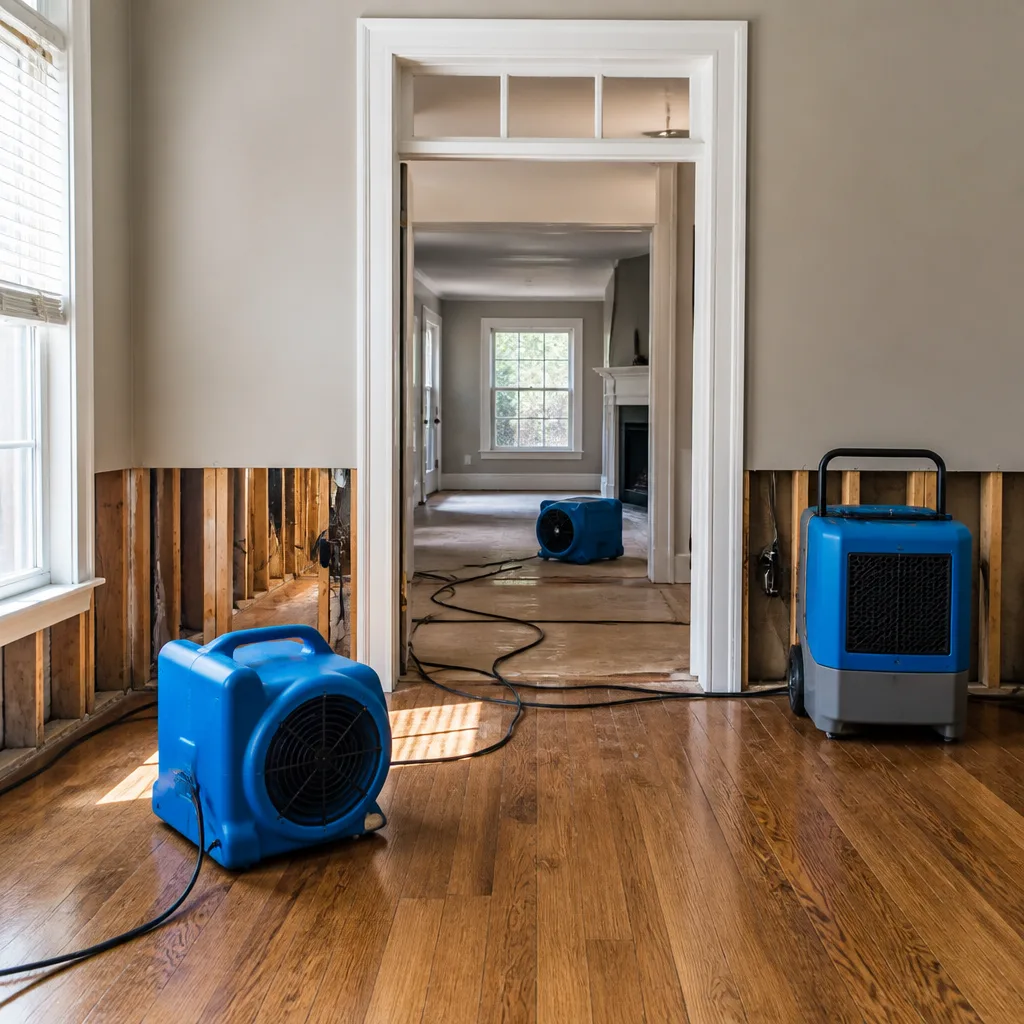
Placement errors are the most frequent culprit. Air movers need a specific pattern: air in, air across, air out. If a room’s air movers all point the same direction, the air just circulates around the room’s perimeter. Moisture in the center of the floor never gets airflow across it. If air movers sit flat on the floor, they skip the baseboards and lower wall cavities where water wicks upward. If a dehumidifier sits in a hallway outside the affected room with the door open, it’s drying the whole house instead of the wet room. Drying systems work on pressure differentials and controlled airflow. Close the affected area, direct air across every wet surface, and match the dehumidifier’s pint-removal capacity to the volume of water in the structure.
Hidden secondary water sources stall drying too. A supply line that wasn’t fully shut off. A drain pan under an AC unit in the attic that’s still slowly dripping. A crawlspace with standing water under the affected room. We’ve seen Fullerton homes where the visible water damage was a laundry room floor, but the actual source was a rusted condensate line from a second-floor AC unit dripping inside a wall cavity. The lower room dried, but the wall cavity kept re-wetting. Until the secondary source is found and stopped, no amount of dehumidification finishes the job.
The third issue is capacity. A single commercial dehumidifier rated for 70 pints per day can handle roughly 150-200 square feet of affected space. If the water event flooded 800 square feet, one unit isn’t enough. Multiple units, or a desiccant dehumidifier for deep structural drying, may be necessary. That’s why professional-grade equipment brands like Dri-Eaz and Phoenix dominate restoration work. They’re rated for continuous operation under load, not intermittent household use.
Signs a Previous Restoration Was Incomplete
We get called to Fullerton homes every month where a previous restoration attempt failed. The homeowner usually knows something’s wrong but can’t articulate what. Here are the signs a previous job wasn’t finished correctly, and what to document for an insurance claim.
- Musty smell returns within 2-3 months. The wall cavity or subfloor was never fully dried. The smell is microbial activity restarting. Document the date you first noticed it and any visible signs.
- Drywall tape starts cracking or bubbling along seams. This indicates the drywall was hung over framing that still held elevated moisture. As the framing finally dried, it shrank slightly, pulling the tape and joint compound.
- Baseboards pull away from the wall or show a light gray-green discoloration at the bottom edge. Moisture is still wicking from the sill plate. Pull one section of baseboard and check the backside for mold staining.
- Flooring feels soft or spongy when walked on. The subfloor is still saturated or has begun delaminating. This is especially common over crawlspaces where the joists weren’t dried before new flooring went down.
- Nail pops appear on interior walls months after the repair. The framing dried and shifted after the wall was closed.
What you need for your insurer: the original scope of work from the first contractor, any moisture readings they took (or the absence of them), photos of the current condition showing the failed areas, and an independent assessment from a credentialed restoration firm that documents what’s still wet and what needs to be reopened. An IICRC-certified assessment carries weight with adjusters because it references an independent standard, not the contractor’s own opinion. That documentation is the difference between a covered supplement and an out-of-pocket repair.
Reading a Psychrometric Chart to Confirm Real Drying
Psychrometrics sounds intimidating, but the core idea is simple: drying is a measurable relationship between temperature, relative humidity, and the moisture content of materials. A psychrometric chart maps those relationships. Restoration professionals use it to calculate two critical numbers: the specific humidity of the air (grains of moisture per pound of dry air) and the dew point (the temperature at which water vapor condenses).
Here’s the practical version. You take three readings in the affected area: dry-bulb temperature, relative humidity, and moisture content of the building materials. You plot the temperature and relative humidity on the chart. You read the specific humidity. You compare it to the specific humidity outside or in an unaffected part of the house. If the affected area’s specific humidity is higher, the air in that space is holding more moisture than it should. If your dehumidifier is working, that number should drop day over day.
The number that actually matters is the material’s equilibrium moisture content, or EMC. Wood, for example, reaches equilibrium with the air around it. If the air in the drying chamber is at 80°F and 50% relative humidity, wood will dry to about 9% EMC. That’s an acceptable final reading in most cases. If the air is at 80°F and 70% relative humidity, wood only dries to about 13% EMC, which is still elevated for interior framing. The psychrometric chart tells you what final moisture reading is actually achievable with the air conditions you’ve created. If the math says the wood can only dry to 13% and you need 9%, you need lower humidity air or higher air temperature.
This is the difference between real drying and surface evaporation. A homeowner sees drywall that looks and feels dry. A restoration professional with a psychrometric chart sees that the air conditions in the room will only pull the framing down to 14% moisture content, and that the wall shouldn’t be closed yet. That’s the documentation that justifies keeping equipment running an extra three days to an insurance adjuster.
Equipment Placement Errors That Stall Every Job
Professional drying equipment only works when it’s placed correctly. The mistakes below show up on job after job, and each one costs days of drying time.
- No vapor barrier or containment. The affected room is open to the rest of the house. The dehumidifier is trying to dry 2,000 square feet instead of 200. Containment with plastic sheeting focuses the equipment on the wet area.
- Air movers flat on the floor. They blow air across the floor but skip the bottom 12 inches of the walls where water wicks upward. Air movers should be angled slightly upward to sweep air across both floor and baseboards.
- One air mover for a large room. Every wet surface needs airflow across it. A single air mover in a 15×20 room leaves the far corners stagnant. Rule of thumb: one air mover for every 10-14 linear feet of wet wall.
- Dehumidifier placed in the wrong room. The unit sits in a hallway outside the affected room. The wet room’s air isn’t being processed. The dehumidifier should be inside the drying chamber, not adjacent to it.
- No airflow under cabinets or behind built-ins. Toe-kick cutouts and drilled access holes allow air to reach the cavity behind cabinets. Without them, the cavity behind a kitchen island or bathroom vanity never dries.
- Equipment turned off at night. Drying is a continuous process. Turning off equipment for 8 hours lets moisture re-accumulate and adds a day or more to the drying timeline.
XPOWER and Phoenix air movers, and B-Air dehumidifiers, are designed to run 24/7 at commercial duty cycles. That’s one of the differences between rental-grade and professional-grade equipment. A restoration company owns the equipment, calibrates it, and places it based on measured airflow patterns, not guesswork. In Fullerton’s summer heat, where evaporation happens fast but so does re-condensation when equipment cycles off, consistent operation matters.
DIY Drying vs Professional Restoration: Where the Line Is
Some water damage situations are safe to handle yourself. A spilled glass of water. A small leak under a sink that you catch immediately and dry within an hour. A wet floor mat. If the water is clean, the affected area is small, and you can fully dry it within 24 hours, a towel and a fan are usually enough.
The line moves quickly though. Here’s when to stop the DIY approach:
- Water soaked into drywall, insulation, carpet pad, or subfloor. These materials don’t dry with towels. They require airflow and dehumidification to prevent mold.
- The water is not clean. Gray water from washing machines or dishwashers, or black water from sewage backups, carries bacteria and requires sanitizing plus proper PPE. This is not a DIY situation.
- The affected area is larger than about 10 square feet. A single fan and a household dehumidifier can’t handle that volume.
- You can’t access the water. Water behind walls, under cabinets, or in crawlspaces needs to be exposed or treated with targeted drying methods before mold takes hold.
- The water event happened more than 24 hours ago. After 24-48 hours, mold colonization begins. The materials may need removal rather than drying.
- You smell mustiness even after drying. That’s microbial activity already underway. Opening walls without proper containment spreads spores through the house.
The equipment-forward approach matters here. A rental dehumidifier from a hardware store typically removes 30-50 pints per day. A professional low-grain refrigerant dehumidifier removes 70-130 pints per day. A desiccant unit removes even more and works better in cooler temperatures. The difference in drying speed is days, not hours, and every extra day of elevated moisture increases mold risk.
Common Mistakes to Avoid
- Closing up walls because surfaces feel dry. Surface dryness means nothing if the cavity behind the drywall still reads elevated. Always verify with penetrating moisture readings before reconstruction.
- Running household fans and a window AC unit instead of a real drying system. House fans move air but don’t remove moisture. A window AC unit cools air, which actually raises relative humidity. This setup can make drying worse.
- Assuming insurance will cover everything without documentation. Insurers require proof of the loss and proof of drying. Undocumented moisture readings, missing photos, and no scope of work from the restoration company weaken the claim.
- Painting over water stains with regular primer. Stains bleed through standard primer. Worse, if the underlying material isn’t dry, the paint traps moisture and accelerates deterioration. Kilz or another stain-blocking primer works only after the material is verified dry.
- Reusing carpet pad after a flood. Carpet pad is cheap to replace and nearly impossible to fully dry in place. Reusing it is a mold risk. The pad should be removed and replaced in almost every flood scenario.
- Ignoring the crawlspace. In Fullerton, many homes sit over crawlspaces. If water reached the subfloor, the crawlspace underneath is part of the drying scope. Unaddressed crawlspace moisture re-wets the subfloor from below.
- Turning off drying equipment to save electricity. The added days of drying time cost more than the electricity. Continuous operation is the only way the drying curve works.
See the difference
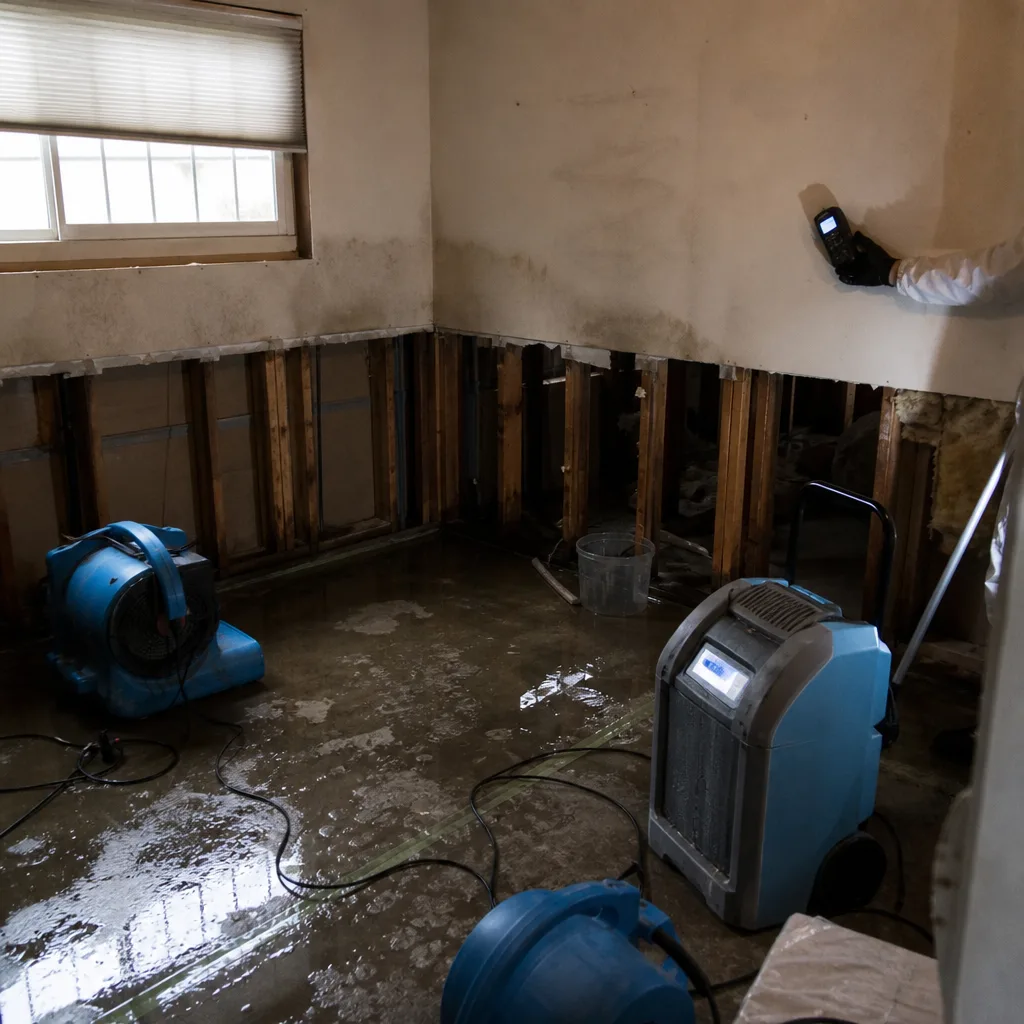 Before
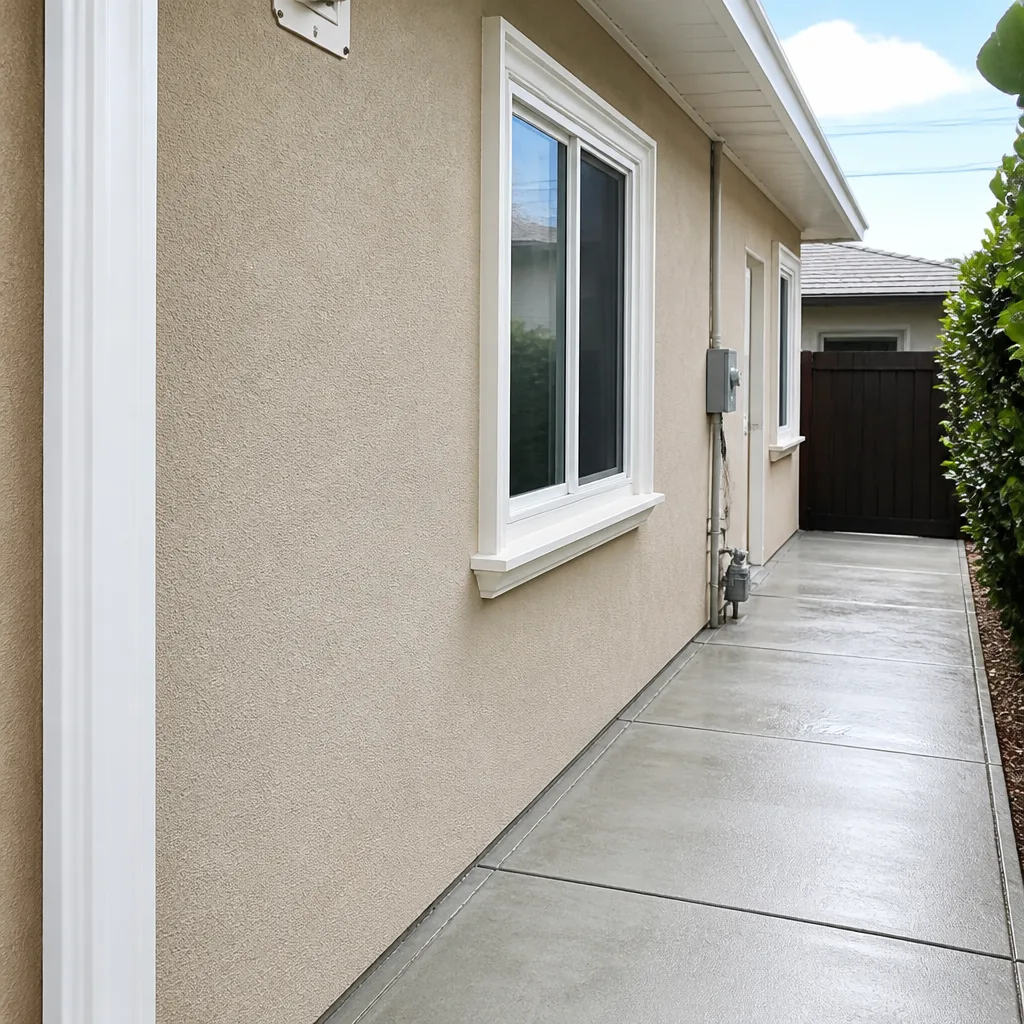 After
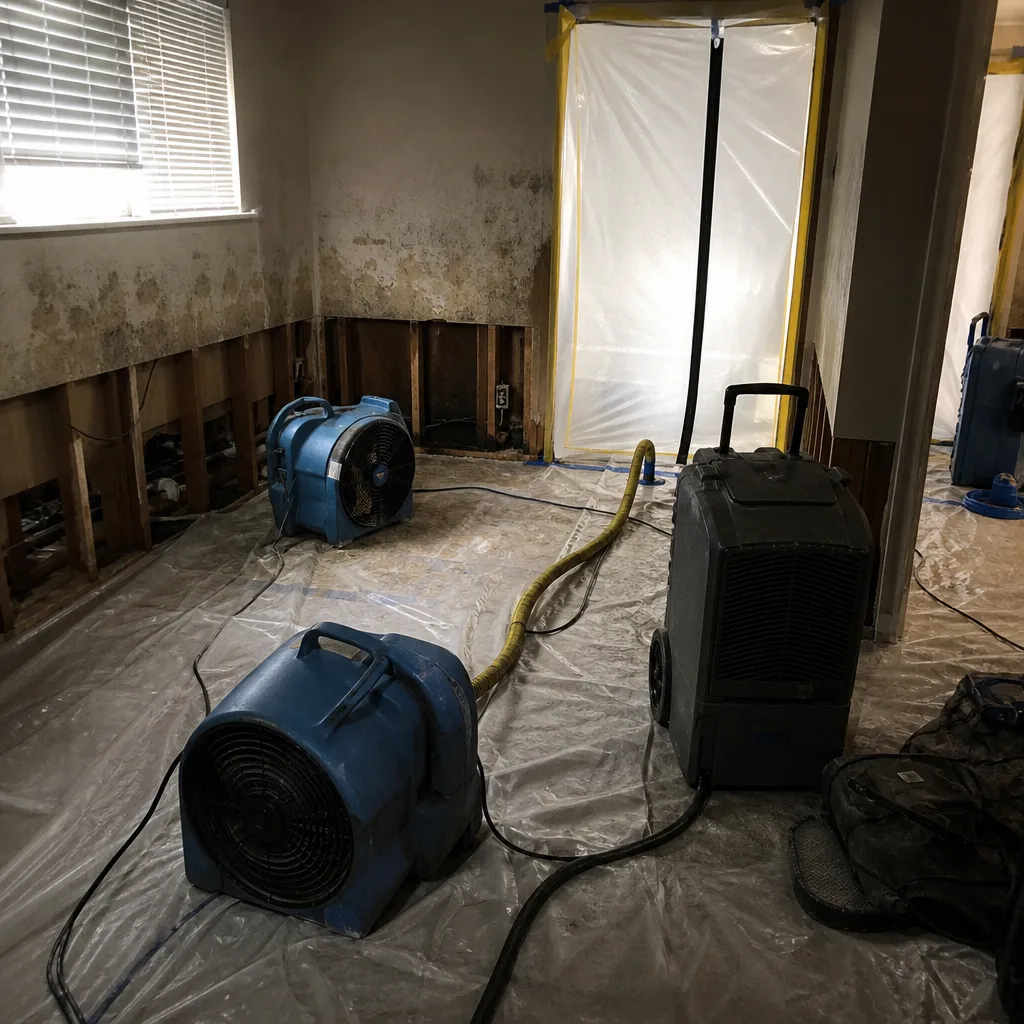 Before
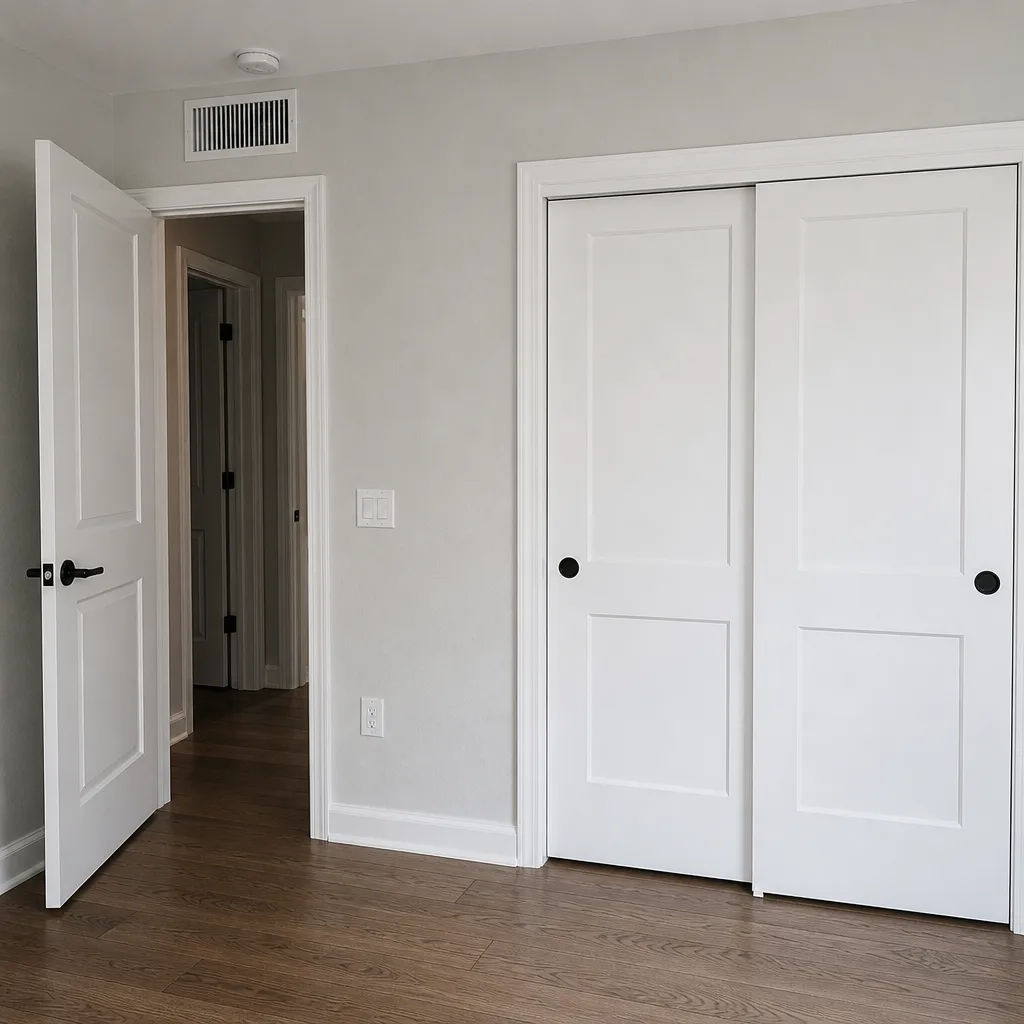 After
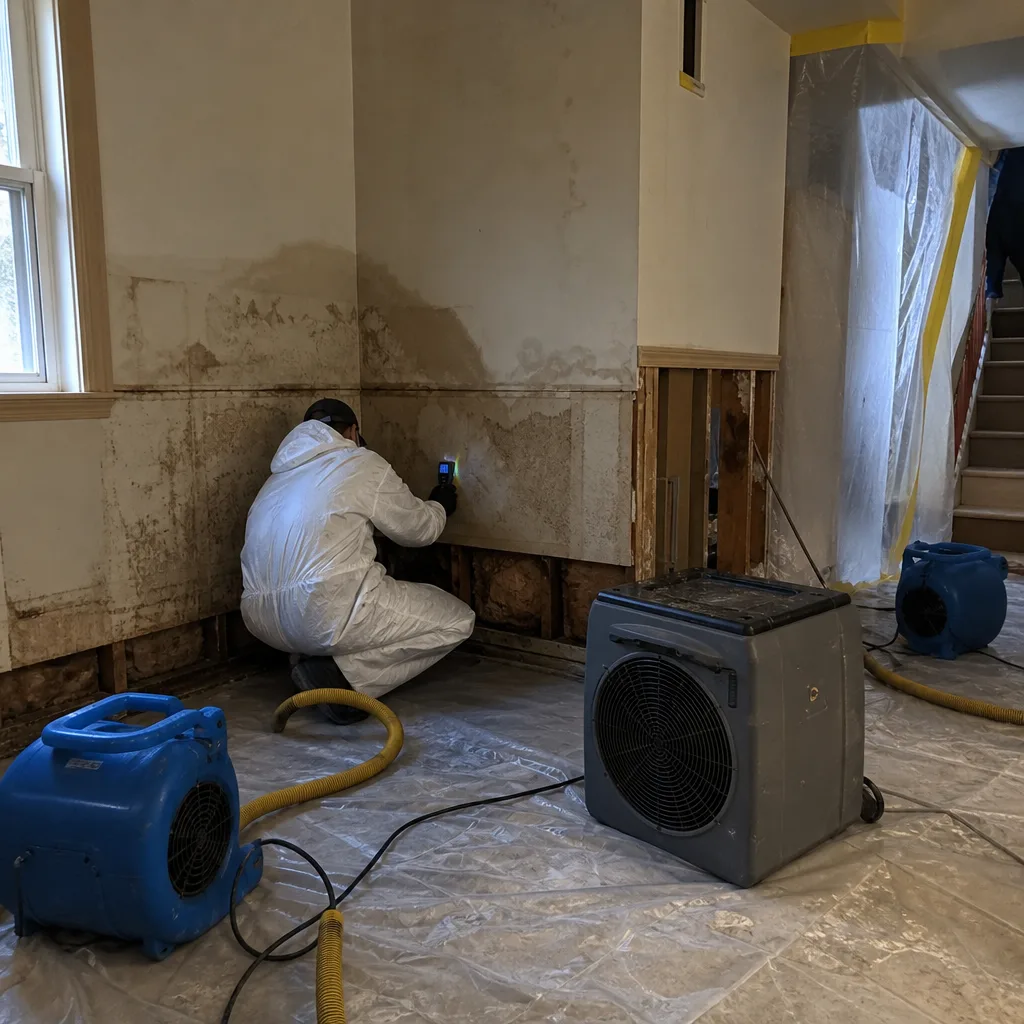 Before
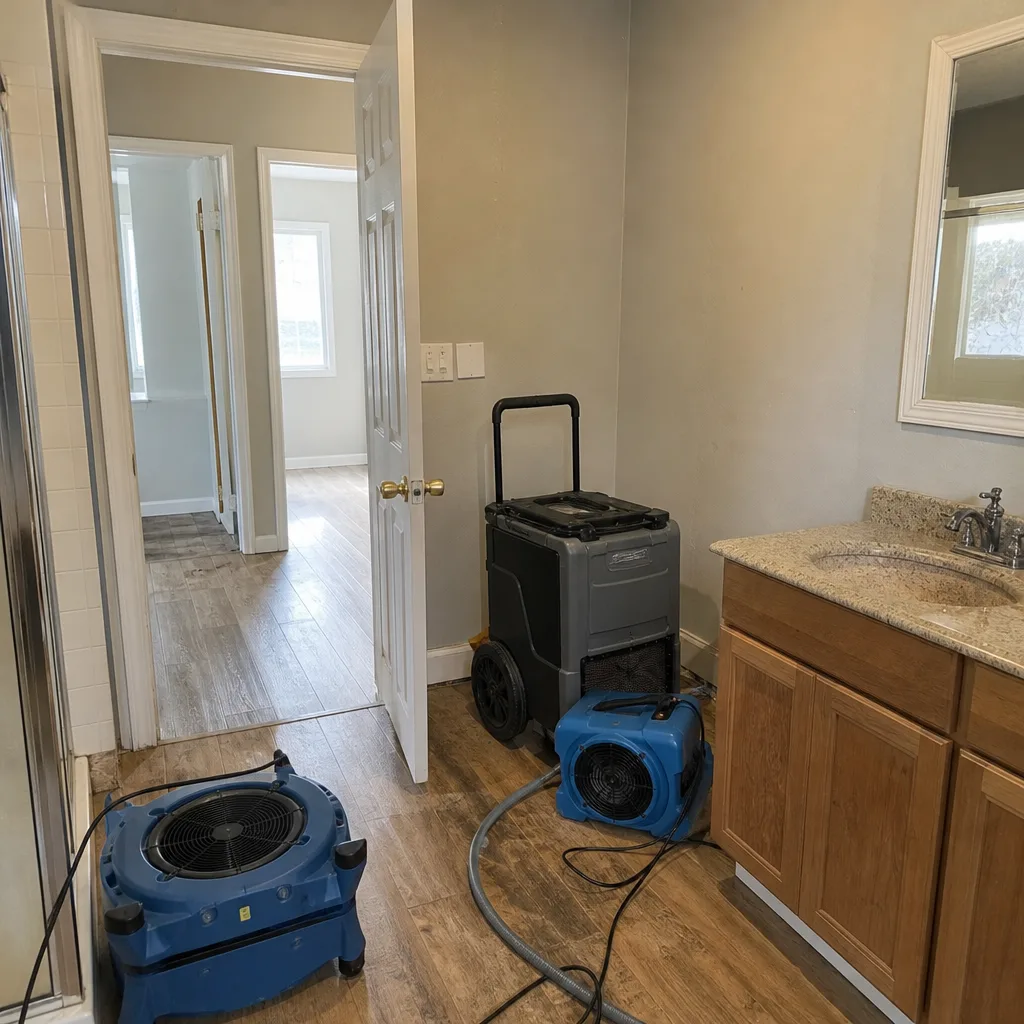 After
When to Call a Professional
Call a restoration professional when water has penetrated building materials, when the affected area is larger than you can dry with towels and a fan, when the water is contaminated, or when the event happened more than 24 hours ago. For additional help, explore more guides & resources on our blog. Also call when a previous restoration attempt failed: musty smell returning, baseboards separating, drywall cracking along seams, or flooring that feels soft. These are signs of incomplete drying that require reopening and re-drying, not another layer of paint. If you’re in Fullerton and dealing with any of these situations, Mahogany Water Damage offers free estimates at (855) 356-4970.
Frequently Asked Questions
Most residential water damage restoration projects in Fullerton take 3-5 days for the drying phase, followed by 1-3 weeks for reconstruction depending on what was removed. Drying is complete when moisture readings in affected materials reach pre-loss levels, documented with penetrating meters, not when a fixed number of days has passed.
Insurance typically covers sudden and accidental water damage, like a burst pipe or appliance overflow, but not gradual leaks or maintenance issues. Your restoration contractor’s documentation, including moisture readings, photos, and a detailed scope of work, is what supports your claim. Direct coordination with your adjuster helps ensure the drying plan is approved before reconstruction begins.
Household dehumidifiers remove 30-50 pints of water per day. Professional restoration dehumidifiers remove 70-130 pints or more. If water soaked into drywall, insulation, or flooring, household equipment can’t create the airflow and dehumidification capacity needed to dry those materials before mold colonizes. It’s not a minor difference; it’s the difference between drying and mold remediation.
Water damage restoration dries and repairs the structure after a water event. Mold remediation removes existing mold growth and addresses the moisture source that allowed it. They overlap: if water damage isn’t dried correctly within 48-72 hours, mold remediation becomes necessary. Mahogany Water Damage handles both, so the drying and any needed remediation after fire or water damage stay under one scope of work.
You need a penetrating moisture meter reading from inside the wall cavity, not a surface reading. Surface meters only read what they touch. The framing behind the drywall can still hold 25-30% moisture while the surface reads 8%. Professional restoration work includes documented cavity readings before reconstruction.
A persistent musty smell after restoration means microbial growth is still active inside a wall cavity, under flooring, or in a crawlspace. The moisture source wasn’t fully eliminated, or the drying wasn’t completed to standard. The area needs to be reopened, inspected, and re-dried with proper containment to prevent spore spread.
The Bottom Line
Water damage restoration fails when drying is judged by feel instead of measurement. Surface-dry walls hide wet cavities. Musty smells mean active microbial growth, not a lingering odor. Equipment that runs without moving moisture is just an electric bill. Real restoration is a documented process: extraction, containment, calculated airflow, dehumidification matched to the water load, and verified moisture readings before anything is closed up. That’s the only way to avoid the six-figure claim that starts with a small leak and a premature “looks dry to me.” If you’re in Fullerton and want a second opinion on a previous restoration or a first response to a current water event, call (855) 356-4970 for a free estimate.
Written by the team at Mahogany Water Damage, serving Fullerton since 2011.