
Last updated October 30, 2026
 Water damage drying
 Fire & smoke cleanup
 Mold remediation
 Storm response
 Sewage cleanup
 Reconstruction
Free visual inspection and a written scope of work before any mitigation begins - photos, moisture readings, and drying logs go in your claim file
The scope we write is the scope we bill. Anything new gets shown to you, in writing, before we touch it.
Get your free estimateThe Complete Water Damage Restoration Guide for Fullerton Homeowners
Here’s the detail most Fullerton homeowners never hear until it’s too late: the majority of homes that develop mold after a water event were pronounced “dry” by a restoration crew that never once lifted a thermal imaging camera. The wall felt fine. The paint looked fine. The cavity behind the drywall, however, was still holding enough moisture to feed mold for months. This guide maps every phase of our Water Damage Restoration services in Fullerton, from the first frantic call to the final clearance test, so you understand what a true restoration requires and what a cosmetic patch job looks like.
Quick Answer
Water damage restoration in Fullerton, CA is a sequenced, equipment-driven process: extract standing water, map hidden moisture with meters and thermal imaging, dry the structure with commercial-grade dehumidifiers and air movers, sanitize affected materials, and verify dryness with documented readings before any reconstruction begins. Skipping or rushing any phase, particularly the verification step, compounds both the damage and the final cost. A legitimate Fullerton restoration job always ends with a written dryness log, not a handshake and a “looks good to us.”
Restoration work we handle
Table of Contents
- Why Fullerton’s Climate Changes the Drying Math
- Category 1, 2, and 3: What the Water Contains Matters
- Class 1 – 4 Water Damage: How Scope Is Determined
- The Equipment Hierarchy: What Each Tool Actually Detects
- The Drying Sequence: Extraction to Verification
- Fullerton Building & Safety: Permits and Documentation
- Insurance Claims and Photo Documentation
Why Fullerton’s Climate Changes the Drying Math
Fullerton sits far enough inland that the marine layer burns off early, leaving long, hot, dry stretches from June through October. That sounds like good news for drying, and sometimes it is. But the same heat that speeds evaporation on the surface also creates a trap: walls and crawlspaces in Fullerton homes can feel bone-dry on the exterior while holding stubborn pockets of moisture deep inside because the ambient air is so thirsty it pulls surface water out rapidly. A contractor using a standard drying calculator calibrated for coastal Orange County humidity levels will shut down equipment too early, and that’s exactly when mold starts.
In our experience in Fullerton, the real variable isn’t the summer heat. It’s the winter inversion layer and the stretches of damp, cool mornings that keep interior relative humidity above 60 percent for days at a time. When outdoor air is humid and cool, drying slows dramatically unless the restorer controls the interior environment with desiccant dehumidification. Refrigerant dehumidifiers lose efficiency below roughly 70 degrees, and Fullerton winter nights regularly dip below that. A restorer who only runs refrigerant units and hopes for warm weather is gambling with your walls.
What this means practically: a Fullerton water damage job needs a drying plan built around measured grain depression and material moisture content, not a generic “three days and done” timeline. The goal is equilibrium with the room, not with the outdoors. That measurement-driven approach is what separates restoration from guesswork. It’s also why we run Mahogany Water Damage home jobs with equipment sized to the structure, not a rental-yard inventory of whatever happened to be on the truck.
Category 1, 2, and 3: What the Water Contains Matters
The IICRC S500 standard divides water damage into three categories based on the level of contamination in the water itself, before any contact with building materials. This classification drives the entire restorer’s approach: what gets dried, what gets removed, and what protective protocols the crew must follow. Fullerton homeowners should understand these categories because they trigger specific health-code and disposal obligations.
- Category 1 (Clean Water): Water from a broken supply line, a failed water heater tank, or an overflowing sink with no contaminants. This water poses minimal health risk at the moment of release. Most materials can be dried in place if the response is fast enough.
- Category 2 (Gray Water): Water with significant chemical, biological, or physical contamination. Common Fullerton sources include dishwasher discharge, washing machine overflow, and sump pump failures. Category 2 water can cause discomfort or sickness on contact. Carpet padding and any absorbent material touched by gray water typically gets removed, not dried.
- Category 3 (Black Water): Grossly contaminated water containing pathogens, sewage, or floodwater from outside. Sewer backups in older Fullerton neighborhoods with aging cast-iron lines fall here. Anything porous contacted by Category 3 water is removed. Hard surfaces require antimicrobial treatment and, often, containment barriers during cleanup.
The practical takeaway: the category can change over time. Category 1 water left standing for 48 to 72 hours in a warm Fullerton room supports bacterial growth and gets reclassified as Category 2. Time matters not just for drying speed but for the entire scope of the job. A fast response on a clean-water pipe break can preserve flooring that a delayed response would condemn to the dumpster.
Class 1 – 4 Water Damage: How Scope Is Determined
While the category tells you what’s in the water, the class tells you how much water entered the structure and how deeply it penetrated. The IICRC uses four classes, and understanding them matters because they directly affect equipment quantities, drying time, and the final invoice on a Fullerton restoration.
- Class 1: Minimal water absorption. Only a small area is wet, often just a corner of a room. Little or no carpet or pad is involved. Drying is typically fast, and equipment needs are minimal.
- Class 2: A large area is affected. Water has wicked up walls less than 24 inches, and carpet and pad are saturated. This is the most common residential class we see in Fullerton, usually from a supply line leak that ran overnight.
- Class 3: Water has come from overhead, saturating walls, insulation, and ceilings. The maximum amount of moisture is absorbed into materials. Fullerton homes with second-floor laundry rooms or attic-mounted water heaters often experience Class 3 damage.
- Class 4: Deep saturation of hard-to-dry materials like hardwood, plaster, brick, and concrete. This requires low-humidity, specialty drying techniques and often aggressive dehumidification. Fullerton neighborhoods with slab foundations and older plaster-and-lath construction see Class 4 conditions more often than newer tract construction.
The class designation is determined after moisture mapping, not before. A restorer who quotes a Fullerton job without documenting moisture readings room by room is guessing. Class also drives the equipment count: a Class 2 job might need four air movers and a single large dehumidifier; a Class 4 job in the same square footage could require double that plus supplementary heat and a desiccant unit. If you want an honest comparison between bids, ask each contractor to state the class they determined and the grain depression they’re targeting.
The Equipment Hierarchy: What Each Tool Actually Detects
Restoration equipment is not interchangeable, and using the wrong tool for the wrong question is how Fullerton homes end up with hidden moisture. Here’s what each class of equipment actually does, and the specific hole each one fills in a proper drying assessment.
- Moisture meters (pin and pinless): These are the first-line tools. Pin meters measure electrical resistance between two probes pushed into the material. Pinless meters use radio frequency to scan a larger area without leaving holes. Neither tells you if there’s water behind a wall, only whether the material itself is wet. A drywall surface can read 6 percent moisture content while the cavity behind it holds 40 percent.
- Thermal imaging cameras: These detect temperature differences, not moisture directly. When water evaporates, it cools the surface, and that temperature differential shows up as a distinct thermal signature. Thermal cameras find the outline of a wet cavity, a saturated ceiling joist, or a soaked wall cavity that a meter would miss because the surface hasn’t wicked anything yet. Without thermal imaging, a restorer is drying based on partial data. This is the tool that catches what the meter misses, and it’s the tool that separates a diagnostic process from a rental-equipment guessing game.
- Refrigerant dehumidifiers: These are the standard workhorses, efficient in warm conditions, pulling water from the air by passing it over cold coils. They work best above 70 degrees. In a Fullerton summer, these are ideal. In a Fullerton winter, their efficiency drops significantly.
- Desiccant dehumidifiers: These use a rotating silica-gel wheel to strip moisture from the air regardless of temperature. They’re essential for Class 4 damage, for crawlspaces, for cold-weather drying, and for pulling water from hard-to-dry materials like hardwood and concrete. They also drive down humidity faster than refrigerant units alone, which speeds the whole job and reduces secondary damage.
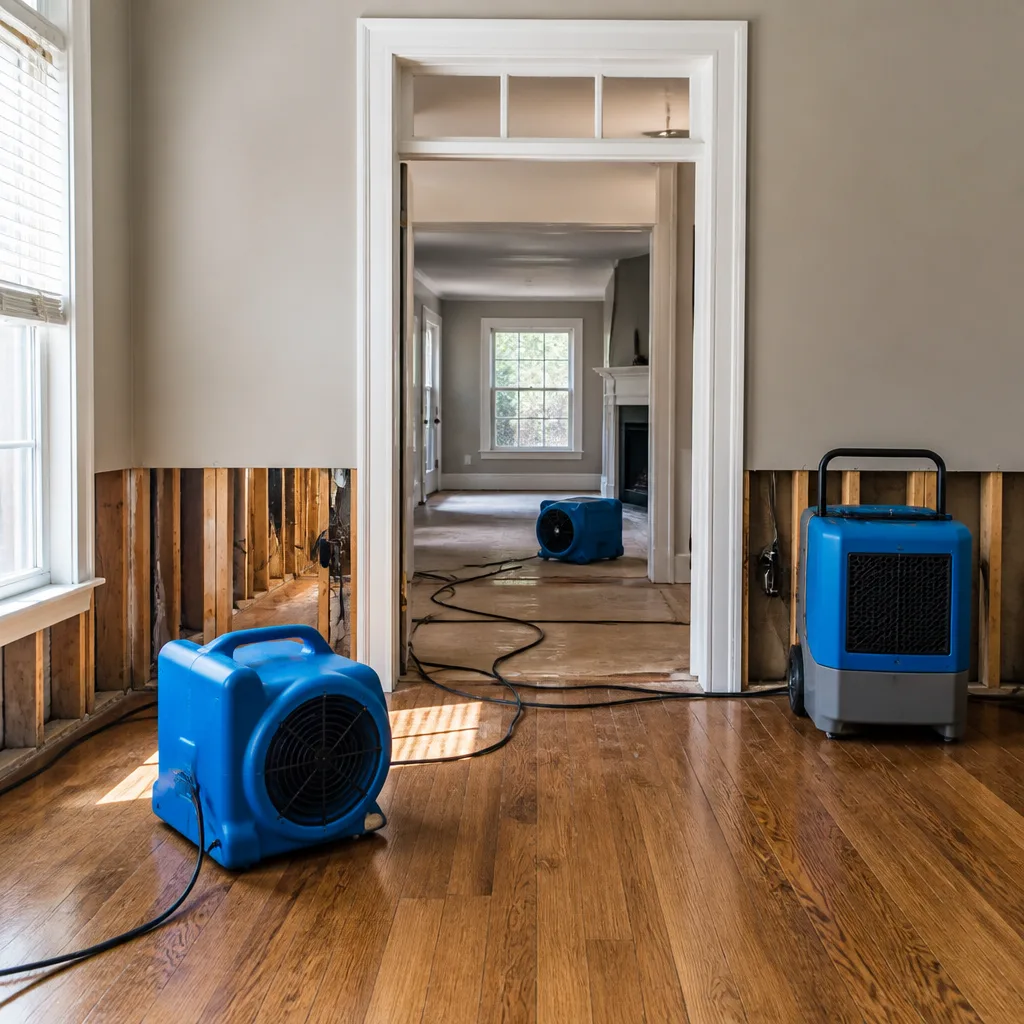
- Air movers: High-velocity fans that create airflow across wet surfaces, encouraging evaporation. The number and placement matter: one fan pointed at a wall is not the same as a calculated airflow pattern that moves water vapor from the material into the air stream for the dehumidifier to capture.
- Injectidry systems: Targeted-injection drying pumps dry air directly into wall cavities, under cabinets, and behind tile without tearing them open. This is the difference between drying a wet wall in place and demolishing it, hauling it to the landfill, and rebuilding it from scratch. Dry smarter, demolish less is not a slogan; it’s a cost and timeline strategy.
The hierarchy matters because one tool answers one question. A moister meter answers “is this material wet?” A thermal camera answers “where is the wet area hiding?” A dehumidifier answers “how do I remove the water vapor from the room?” A desiccant answers “how do I remove it when it’s cold or the material is stubborn?” The contractor who only runs fans and one dehumidifier is not restoring, they’re airing out the room and hoping. In Fullerton, with its hot dry summers and cool damp winters, the season dictates which dehumidifier is doing the real work.
The Drying Sequence: Extraction to Verification
A legitimate water damage restoration in Fullerton follows a documented sequence. Skipping a step means redoing the work later at a much higher cost, often with mold remediation added to the bill. Here is the sequence we follow, and the technical checkpoint at each phase.
- Emergency extraction. Standing water is removed using truck-mounted or portable extraction equipment rated for the volume present. The checkpoint: no standing water remains, and the carpet feels damp but not saturated. Every hour of standing water moves the job one class upward.
- Moisture mapping. A restorer documents the affected area with a thermal camera and moisture meter, room by room. The checkpoint: a floor plan sketch with readings at each grid point, saved for the insurance file. If your contractor can’t show you this document, they haven’t done this step.
- Equipment placement. Air movers and dehumidifiers are positioned based on the class and mapped readings. The checkpoint: every wet surface has direct airflow, and the dehumidifier’s capacity is sized to the cubic footage and the target grain depression, not a rule of thumb.
- Daily monitoring. The restorer returns daily to take updated readings, adjust airflow patterns, and track the drying curve. The checkpoint: a drying log that shows material moisture content trending down. If the numbers aren’t moving, the equipment plan changes.
- Targeted drying (when applicable). For cavities, under cabinets, and behind built-ins, Injectidry panels push dry air into confined spaces. The checkpoint: the cavity reaches dry standard without demolition access holes.
- Verification. Final readings are taken and compared against the dry standard for that material in Fullerton’s climate conditions. The checkpoint: a written dryness log that shows every affected material is at or below the established equilibrium moisture content for the region, not just “feels dry.”
- Clearance. Equipment is removed, and the restorer documents the job as complete with photos, readings, and a scope of what was dried versus removed. The checkpoint: no active water source remains, and the moisture map shows clean readings across the entire affected area.
This sequence is what you’re paying for. The average Fullerton homeowner can’t verify grain depression numbers themselves, but they can verify that the contractor produced a drying log, used a thermal camera, and didn’t pick up equipment the first day the surface felt dry—tips you’ll find in our Damage Restoration Emergency Preparedness Guide for Fullerton Homes. Ask for the log. If they can’t produce one, the job isn’t done.
Fullerton Building & Safety: Permits and Documentation
Here’s the part most restoration guides skip, and it matters more than any equipment spec: Fullerton Building & Safety has requirements that affect what gets permitted and what gets documented during and after a water loss. The permit trigger isn’t the drying itself; it’s the reconstruction that follows when materials are removed.
When a water damage restoration in Fullerton requires removal of drywall, insulation, flooring, or structural components, the rebuild portion typically falls under Fullerton’s building permit requirements. This is not a technicality. Unpermitted reconstruction can complicate a future home sale, trigger issues with your homeowner’s insurance claim, and in some cases result in a stop-work order on your own property.
The practical steps: confirm with your restorer which portion of the job is emergency mitigation, which is repair, and which requires a permit. Emergency water extraction, drying, and antimicrobial treatment don’t require permits in Fullerton. Cutting out wet drywall doesn’t require a permit. Replacing that drywall with new material, relocating any plumbing, or altering any electrical does. A good restoration contractor coordinates with Fullerton Building & Safety on the back end of a major loss, and the insurance adjuster expects to see permit documentation in the file when structural work was done.
For Fullerton homeowners dealing with a significant loss, the documentation trail matters as much as the drying itself. Photos of the moisture map, photos of each phase, the daily drying log, and the final clearance readings all become part of your claim file. The more complete that file, the less friction with your carrier. Water Damage Restoration in Fullerton work that’s undocumented is, from an insurance perspective, work that never happened.
Insurance Claims and Photo Documentation
Insurance is in the room on nearly every Fullerton water damage job, whether you’re a homeowner with a standard policy or a property manager with a commercial carrier. The claim process starts before the first fan gets plugged in, and the quality of the documentation drives the quality of the settlement.
What your adjuster needs: photos of the water source, photos of all affected areas before any equipment is placed, a room-by-room moisture map with readings, a drying log showing daily progress, and a final clearance document. What your adjuster doesn’t need: verbal assurances that everything is dry. Adjusters work from files, not from memories.
The best Fullerton restoration contractors document as they go, photograph everything, and can hand the adjuster a complete file that supports every line item. That file is also your protection against a claim being underpaid because the carrier’s independent reviewer couldn’t verify the scope. When an IICRC-certified process is followed and documented, the adjuster has less room to dispute what was necessary.
One thing we tell Fullerton homeowners repeatedly: never let a contractor start demolition without photo evidence of what was demolished and why. Once the wet drywall is in a dumpster, it can’t be photographed. The moment of demolition is the most expensive moment in the whole restoration, and it’s the moment that’s hardest to justify after the fact. A restorer who documents the “before” thoroughly is protecting you from a fight later.
Common Mistakes to Avoid
- Declaring the job done when the surface feels dry. Fullerton’s dry summer air can make walls feel dry while cavities still carry moisture high enough to support mold. Verify with a moisture meter, not a touch test.
- Using only refrigerant dehumidifiers in winter. When Fullerton temperatures drop, these units lose efficiency, and the drying curve stalls without anyone noticing. Desiccant units are the fix that a less-equipped crew won’t have on the truck.
- Skipping thermal imaging. A meter tells you what you’re touching is wet. A thermal camera tells you where the wet area is that you can’t touch. Both are required on a legitimate Fullerton restoration.
- Leaving wet carpet pad in place. Carpet pad is a sponge, and once saturated with Category 2 or worse, it’s a biological time bomb. It gets replaced, not dried, on most jobs.
- No daily drying log. The insurance adjuster can’t see effort; they can only see readings. No log means no verification, and no verification means disputes later. Insist on the written record.
- Ignoring the permit threshold. In Fullerton, emergency mitigation is exempt from permits, but reconstruction is not. A contractor who says nothing needs a permit on a major rebuild is wrong, and the problem lands on you in escrow.
- Hiring based on the lowest equipment count. Two fans and a dehumidifier from a rental yard is not a restoration plan. The class of damage dictates the equipment count, and no honest contractor quotes a price without first mapping the moisture.
See the difference
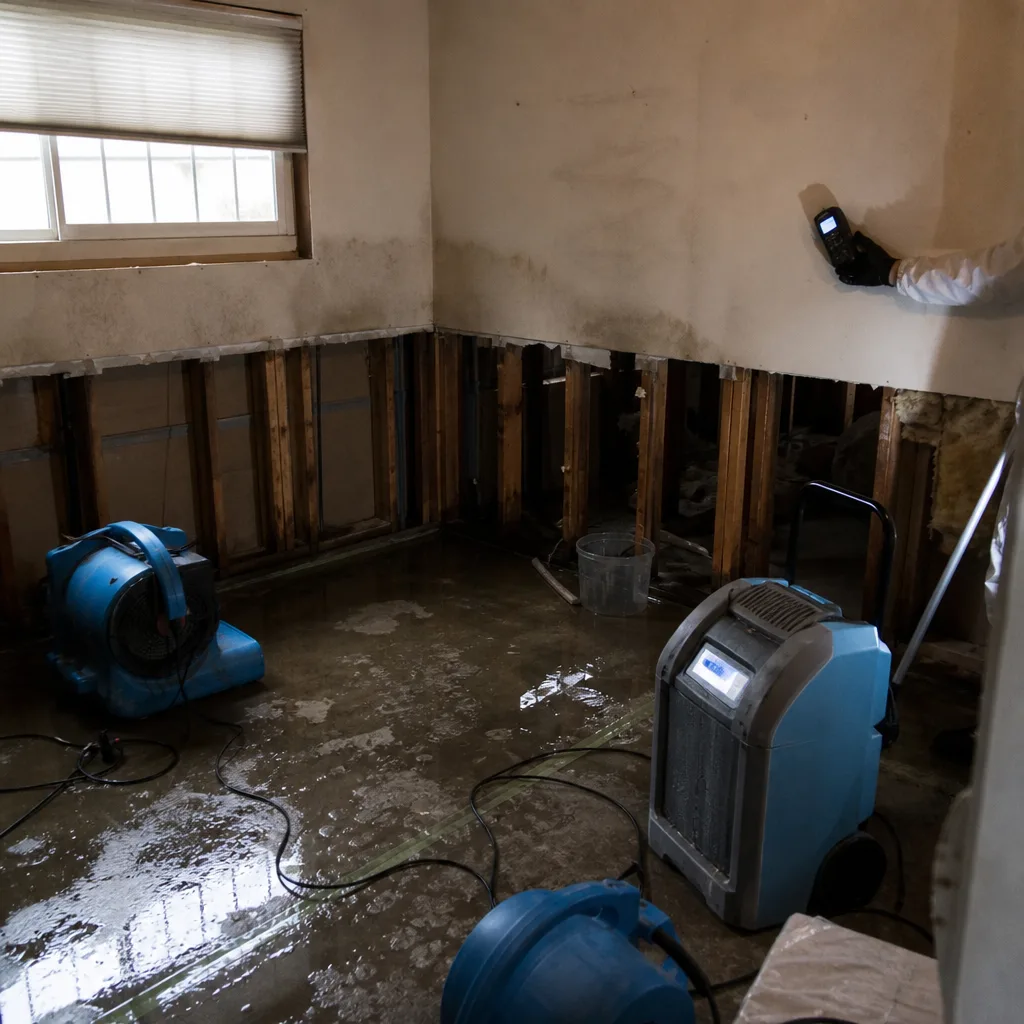 Before
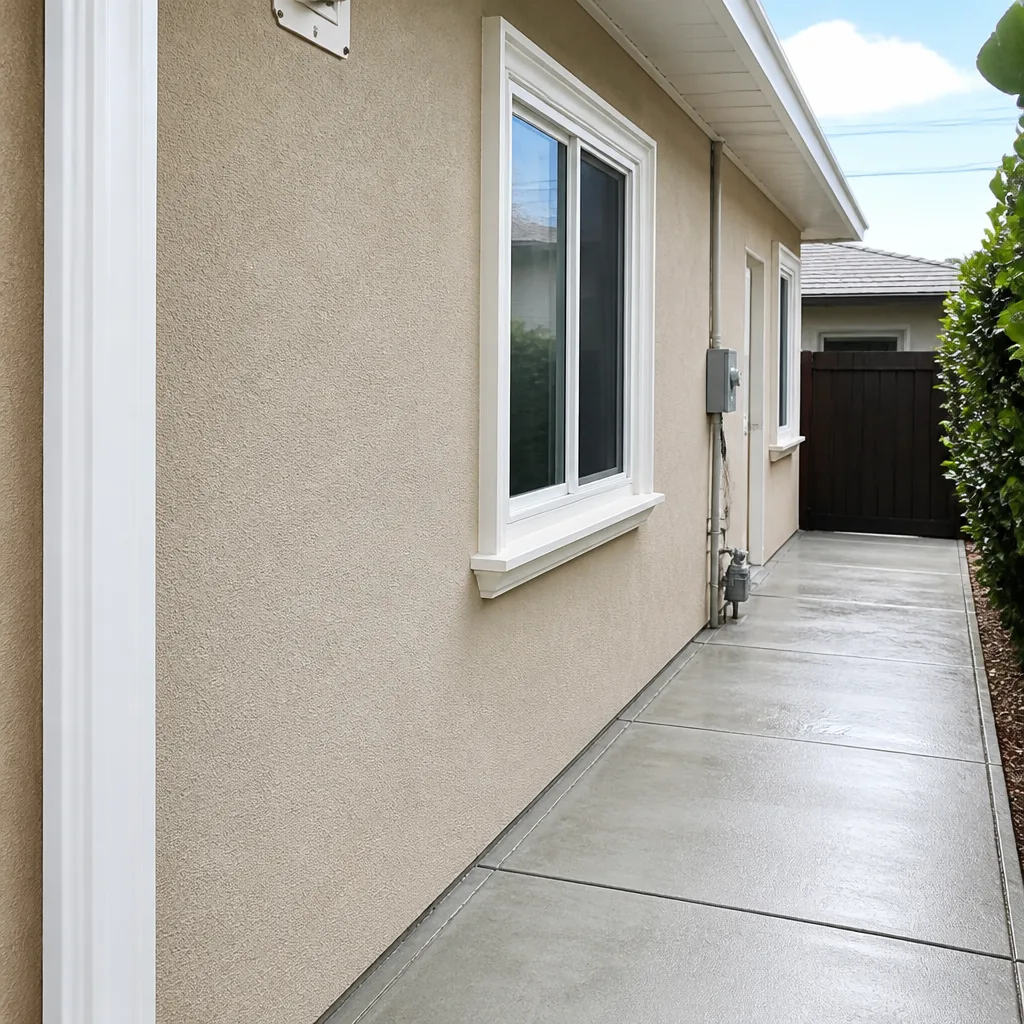 After
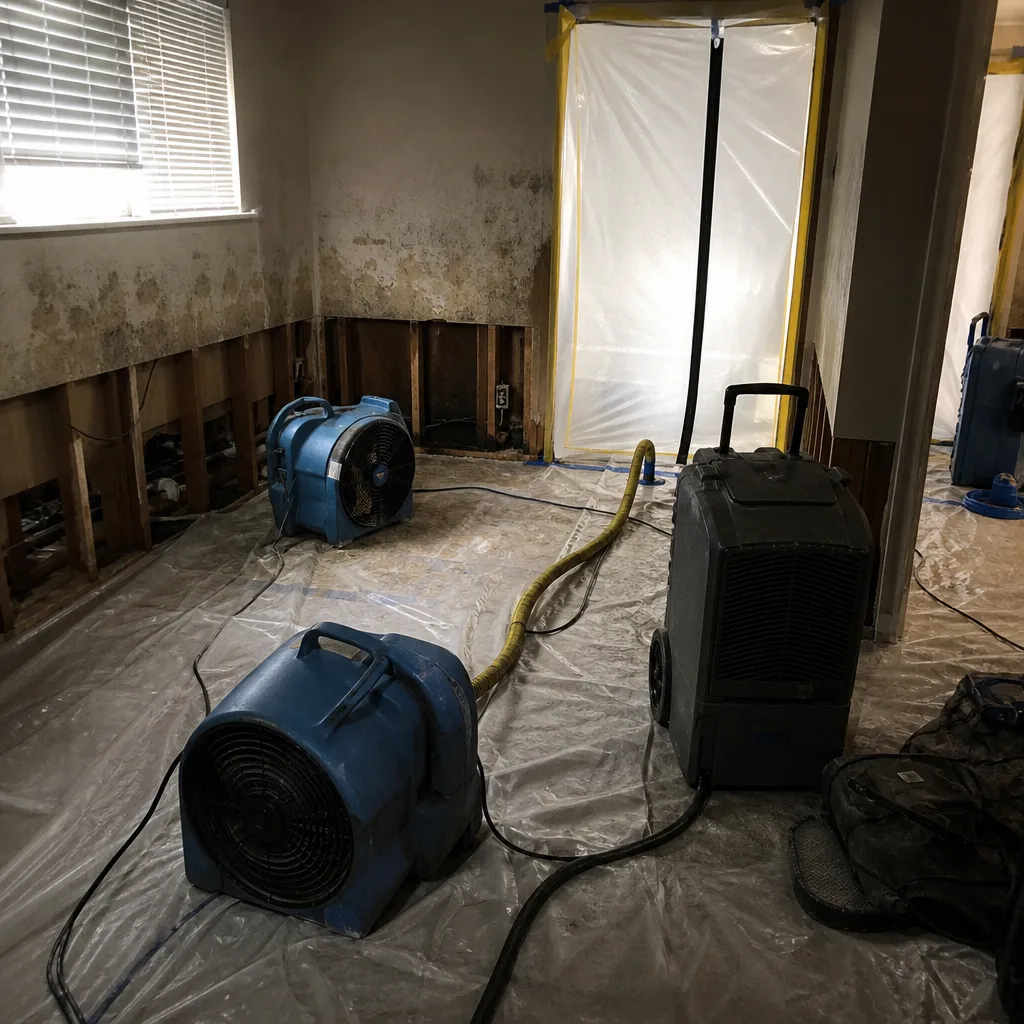 Before
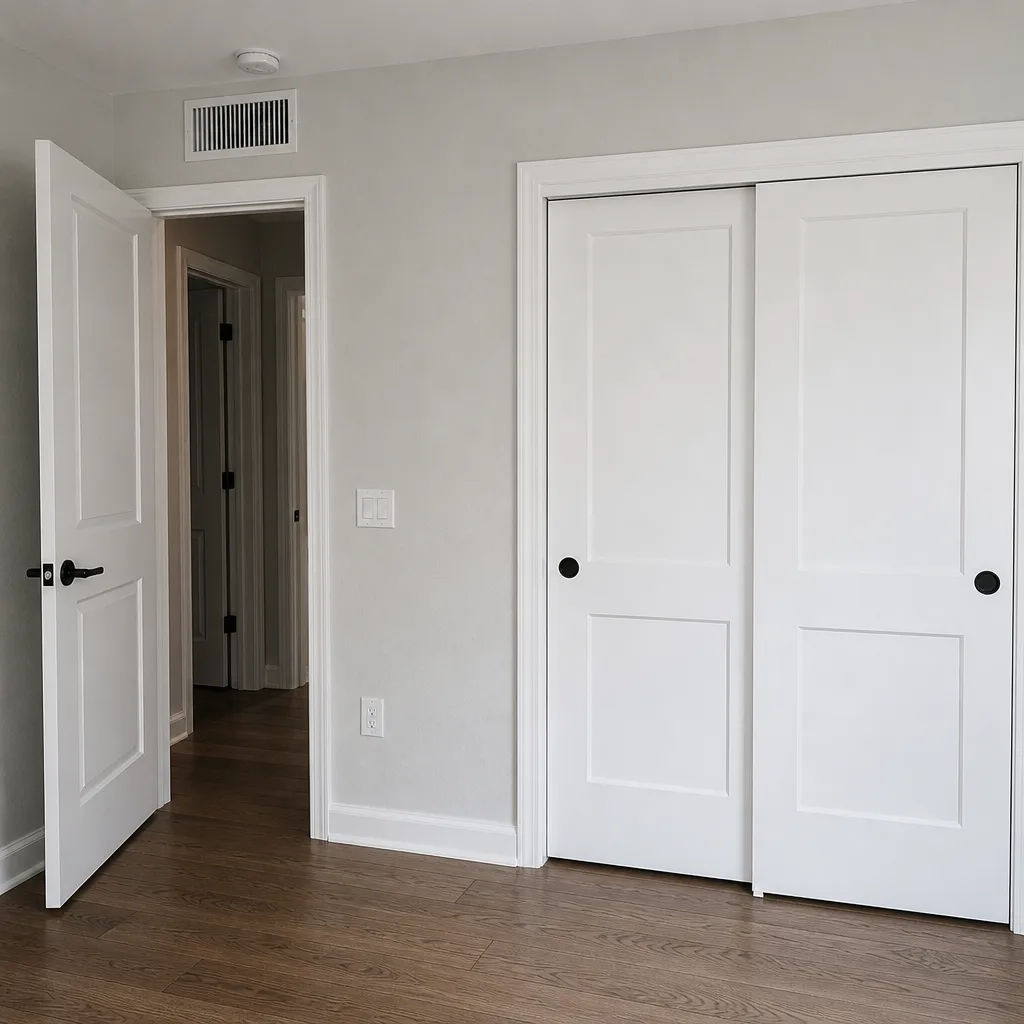 After
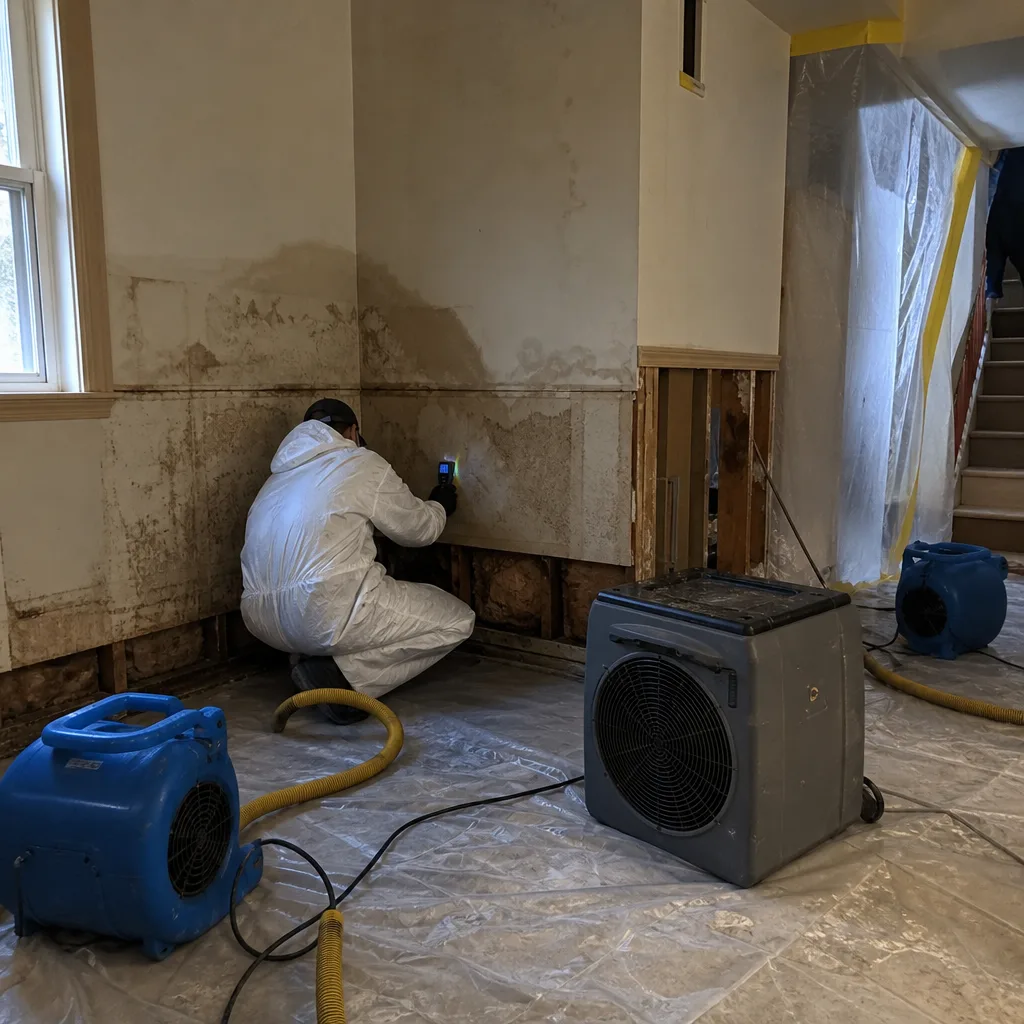 Before
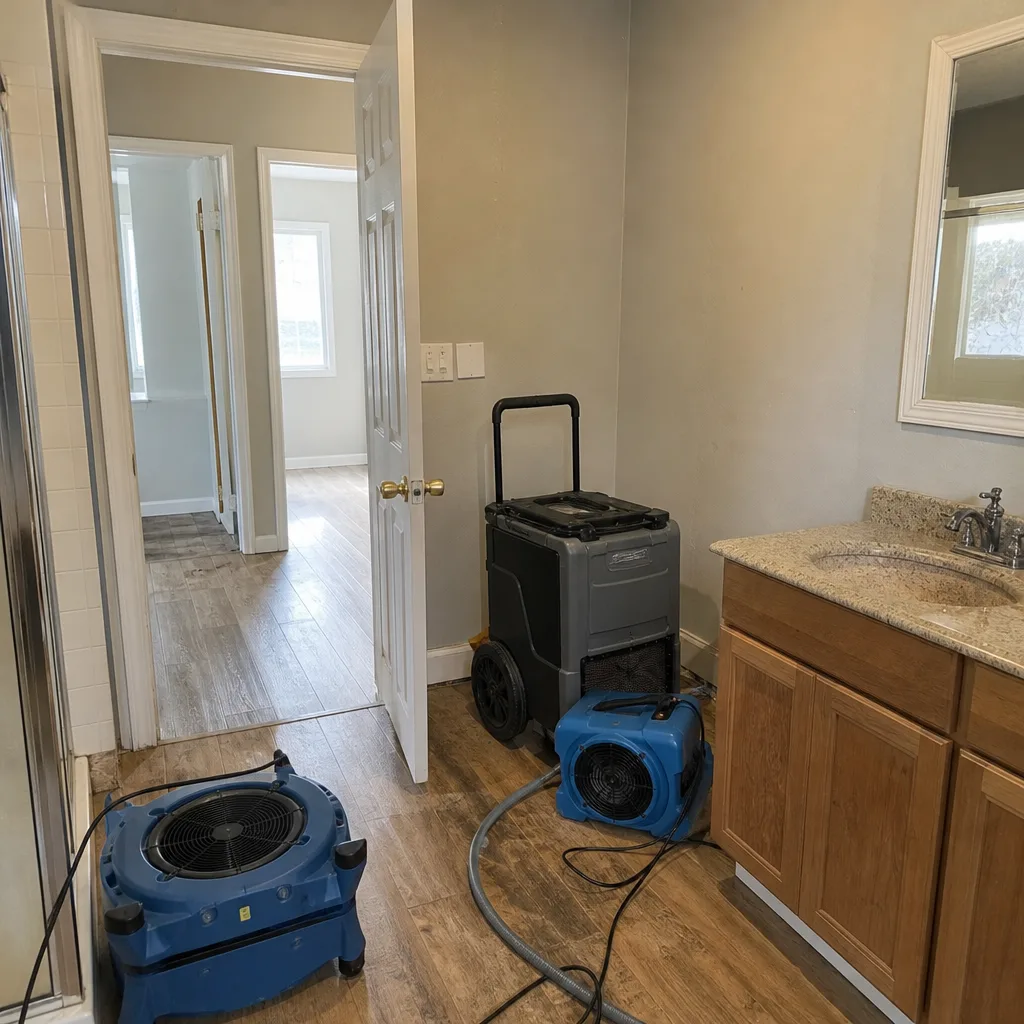 After
When to Call a Professional
Call a professional the moment the water source is stopped if any of these conditions are true: the water came from a sewer line or contains visible contamination, the water has been present for more than 24 hours, the affected area includes walls, ceilings, or flooring, the water entered a crawlspace or wall cavity, or you can smell any mustiness. These are the situations where the damage spreads invisibly, and the cost of waiting compounds daily. Mahogany Water Damage offers free estimates in Fullerton, call (855) 356-4970 for an inspection and a written scope before any work is authorized.
Frequently Asked Questions
Water damage restoration in Fullerton typically ranges from $1,500 to $4,000 for a Class 2 single-room job, and $8,000 to $25,000 or more for Class 3 or Class 4 damage involving multiple rooms, ceilings, or structural drying—see our Damage Restoration Cost Breakdown: The Fullerton Homeowner’s Reference for 2026 for a detailed analysis. The variables are the class of damage, the category of water, and whether materials can be dried in place or must be removed and rebuilt. Call (855) 356-4970 for an exact scope and estimate; the assessment is free.
A properly equipped drying job in Fullerton typically takes three to five days for Class 1 and Class 2 damage, and five to ten days or more for Class 3 and Class 4 damage involving hardwood, plaster, or concrete. The timeline depends on the season, with summer drying faster due to the inland heat, and winter drying slower unless desiccant dehumidification is used. Your contractor should provide a written drying log with daily readings to prove the structure is actually drying.
Most Fullerton homeowners policies cover sudden and accidental water damage, such as a burst supply line or an overflowing appliance, but not water from gradual leaks, seepage, or maintenance failures. Coverage also depends on the water category: clean-water losses are typically covered, while sewer backups may require a specific endorsement. Document everything with photos before any demolition, and let your restoration contractor coordinate directly with the adjuster.
Wet drywall from clean-water sources can often be dried in place if the response happens quickly and the moisture hasn’t compromised the gypsum core’s structural integrity. Category 2 or Category 3 water usually means removal, as does any drywall that’s been wet long enough to develop visible swelling, staining, or odor. Injectidry cavity drying can save walls that would otherwise be demolished by a contractor who lacks the equipment to dry them in place.
Drying is complete when a moisture meter shows that every affected material has reached its dry standard, documented in a written dryness log, not when the surface feels dry to the touch. In Fullerton’s climate, equilibrium moisture content varies by season, and the final readings should be compared against the appropriate regional standard. Ask your restorer to show you the numbers before they pack up the equipment.
Emergency water extraction, drying, and antimicrobial treatment do not require permits from Fullerton Building & Safety. However, the reconstruction that follows a major loss, including drywall replacement, flooring installation, or any electrical or plumbing changes, typically does. A qualified Fullerton restoration contractor should tell you exactly which portions of the job are permit-triggering and handle the coordination.
A restoration company is IICRC-certified and equipped with commercial-grade drying equipment from manufacturers like Dri-Eaz, Phoenix, and Injectidry, and follows documented moisture-mapping and drying protocols. A general contractor handles framing, drywall, and finish work but typically lacks the diagnostic tools and drying expertise to mitigate an active water loss properly. The best approach on a Fullerton job is a restoration team that handles the full sequence, water, mold, and fire, under one roof, without subcontracting the critical phases.
The Bottom Line
Water damage restoration in Fullerton is a measurable process, not a judgment call. A legitimate job starts with a moisture map, runs on commercial-grade equipment matched to the damage class, and ends with a written verification that every affected material has reached dry standard. Anything less is airing out the room and hoping. When a crew shows up with a thermal camera, a moisture meter, and a desiccant on hand, you’re working with a restorer. When they show up with fans and a portable rental dehumidifier, you’re not. The difference is the mold that never grows and the wall that never gets torn out. If you’re facing a water event in Fullerton, get the documented process, ask for the log, and don’t settle for a handshake when a moisture reading is what matters. For water, mold, or fire damage, Mold Remediation in Fullerton and Fire Damage Restoration in Fullerton are handled by the same team, start to finish. Call (855) 356-4970 for a free estimate and a written scope before any work begins.
Written by the team at Mahogany Water Damage, serving Fullerton since 2011. Explore more guides & resources on our blog.