
Last updated October 30, 2026
 Water damage drying
 Fire & smoke cleanup
 Mold remediation
 Storm response
 Sewage cleanup
 Reconstruction
Free visual inspection and a written scope of work before any mitigation begins - photos, moisture readings, and drying logs go in your claim file
The scope we write is the scope we bill. Anything new gets shown to you, in writing, before we touch it.
Get your free estimateChoosing the Right Damage Restoration Brand: A Buyer’s Guide for Fullerton
Here’s a number that should make every Fullerton homeowner pause: roughly 40% of “restoration companies” that show up after a water event are actually marketing front-ends that sell the job to whichever subcontractor answers the phone first. That means the brand on the truck is often not the company doing the work. This guide—along with The Complete Guide to Damage Restoration in Fullerton—strips away franchise gloss and yard-sign familiarity to examine the two factors that actually predict a good outcome in Fullerton: who owns the drying equipment and which certifications are current, verifiable, and tied to the crew that walks through your door.
Restoration work we handle
Quick Answer
The best damage restoration company in Fullerton is one that owns commercial-grade drying equipment outright, holds active IICRC certification you can verify in under two minutes, and manages water, mold, and fire damage under one roof with documented processes. That combination beats brand recognition every time, because it means the crew arriving is the same crew accountable for the result. In Fullerton, we’ve watched homeowners pay premium prices for franchise names while a two-dehumidifier operation does the actual extraction.
Table of Contents
- The Franchise Model vs. the Independent Specialist: What Actually Differs
- Why Equipment Ownership Predicts Job Quality
- How to Verify Active vs. Lapsed IICRC Certification in Real Time
- What Documentation Practices Reveal About a Company’s Process
- Fullerton-Specific Factors: Housing Stock, Permits, and the 72-Hour Window
- Twelve Questions to Ask Before You Sign Anything
- Insurance Navigation: Photo Documentation and Adjuster Coordination
- Common Mistakes to Avoid
- When to Call a Professional
- Frequently Asked Questions
- The Bottom Line
The Franchise Model vs. the Independent Specialist: What Actually Differs
National restoration franchises operate on a licensing model. A local owner buys the rights to the brand name, the software systems, and sometimes a preferred equipment list. But the technicians who show up are employed by that local franchisee, and in many Fullerton cases, the franchisee sub-contracts overflow work to independent crews who never appear on the franchise’s website. The franchise itself provides marketing, standardized pricing tiers, and a recognizable logo. It does not guarantee that the person holding the moisture meter has IICRC certification or that the dehumidifiers on the truck belong to the company.
An independent specialist like Mahogany Water Damage home operates differently by structure, not just by preference. We own our equipment fleet. Our technicians are our employees, not day-laborers booked through a dispatch app. When a job goes sideways, the person you call is the person who owns the problem. That structural difference matters more than any brand promise. In Fullerton, where homes range from 1920s Spanish Colonials to 1990s track housing, you need a team that adapts process to construction type, not one following a franchise playbook written for a national average.
Franchise affiliation is not inherently bad. Some franchise owners run tight operations. But the model introduces distance between the homeowner and the accountable party. You are not hiring “the brand.” You are hiring whoever the brand dispatches. Ask the question directly: “Who will do the work, and are they your direct employees?” The pause before the answer tells you everything.
Structural Differences That Matter
- Accountability: An independent specialist answers for its own work. A franchise routes complaints through a corporate resolution process that can take weeks.
- Equipment ownership: Independent specialists who invest in owned equipment deploy it immediately. Franchises often rent or share equipment across multiple job sites, which affects scheduling.
- Certification continuity: An independent firm’s IICRC certification is tied to its name and its technicians. A franchise’s certification may belong to a corporate entity that never visits your home.
- Scope flexibility: Independent specialists can adjust drying protocols mid-job based on actual psychrometric readings. Franchise protocols are designed for consistency across thousands of jobs, not optimization on your specific one.
The equipment-forward specialist model is not a compromise against a big brand. It is often the only model where the words “we” and “ours” describe the same people every time.
Why Equipment Ownership Predicts Job Quality
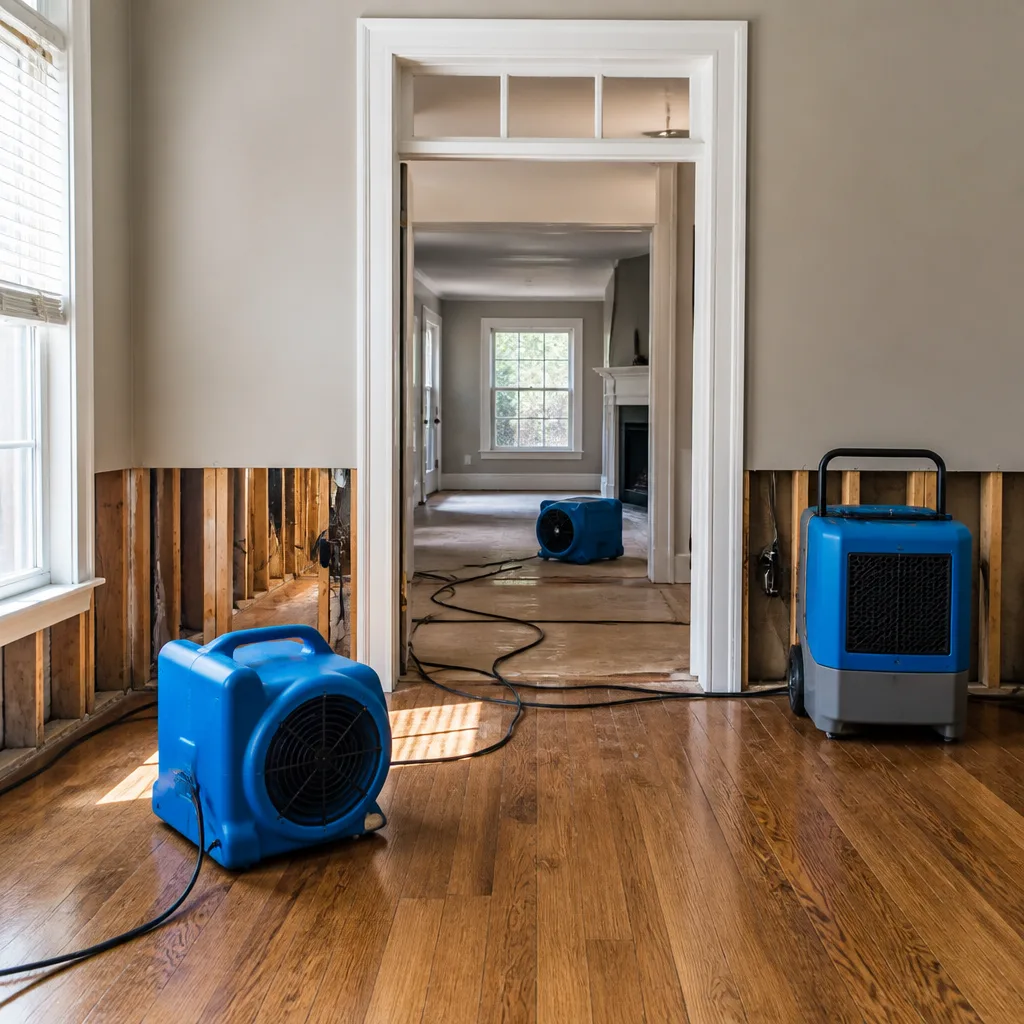
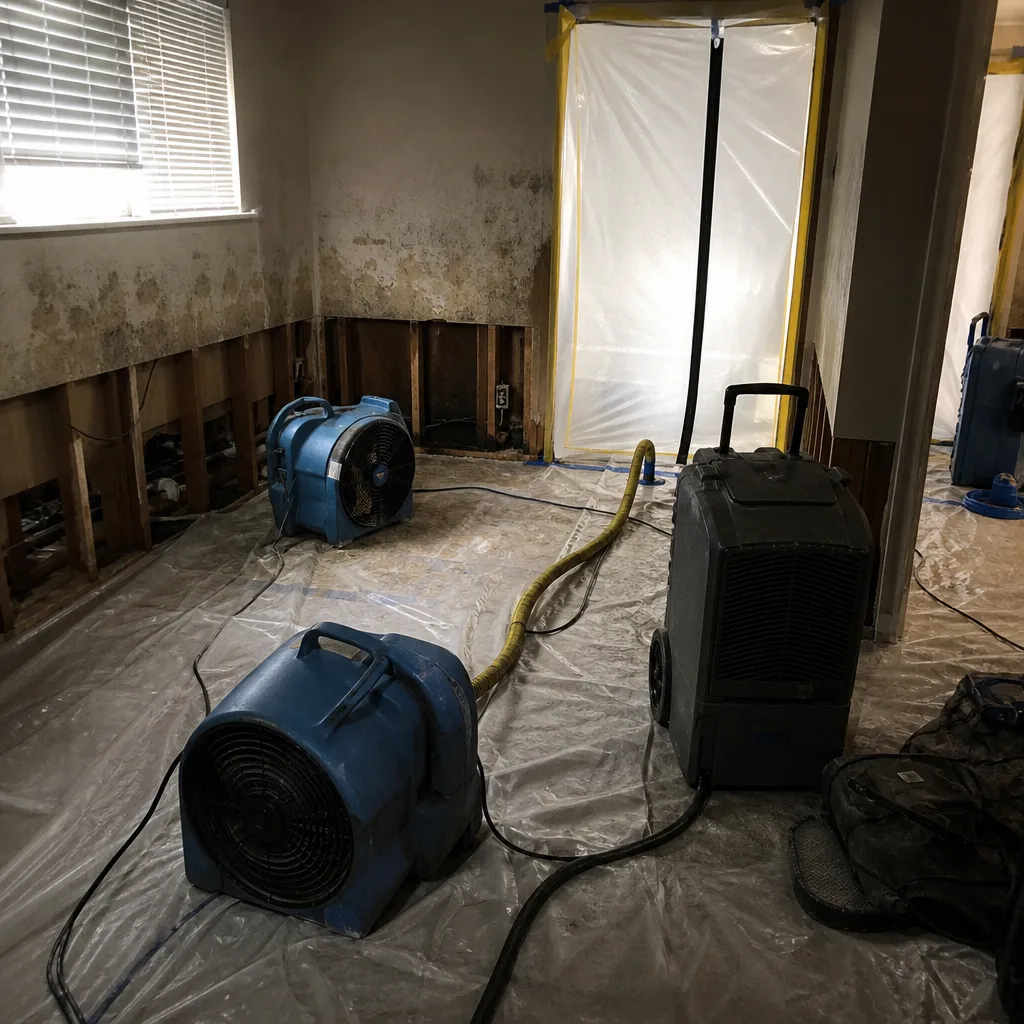
Water damage restoration is a physics problem. Remove moisture faster than it spreads, and you save drywall, flooring, and studs. Fail to remove it within 72 hours, and microbial growth begins in Fullerton’s warm, dry climate. The tools that do this work are industrial dehumidifiers, high-velocity air movers, and negative air pressure systems—equipment covered in detail in The Complete Water Damage Restoration Guide for Fullerton Homeowners. The brands that dominate commercial restoration are Dri-Eaz, Phoenix, XPOWER, and B-Air. These units cost between $2,000 and $6,000 each. A serious water damage job in a Fullerton living room and adjacent hallway requires ten to twenty of them.
Companies that rent equipment face structural pressure to finish jobs quickly and return the units. When another job books, the rental pool shrinks. A crew might pull two dehumidifiers from your site on day three to cover a new claim across town, hoping the remaining units suffice. They rarely do. Moisture rebounds behind baseboards and inside wall cavities. Six weeks later, you smell it.
Companies that own their fleet have no incentive to pull equipment early. The units are paid for. They sit on your job until the moisture readings hit the target, not until the rental invoice demands return. That is the difference between “dry enough to leave” and “dry to documented standard.”
Equipment Ownership Checklist
- Ask the number of dehumidifiers and air movers the company owns. A legitimate restoration firm should answer without hesitation. If they deflect to “whatever the job requires,” that is a rental answer.
- Ask for brand names. Dri-Eaz and Phoenix are commercial workhorses. A company that cannot name its equipment brands is not operating a restoration fleet.
- Ask about specialized systems. Injectidry targeted-injection drying saves walls and floors that less-equipped companies would tear out. If the company has never heard of it, they are not equipment-forward.
- Ask who performs maintenance. Owned equipment requires calibration and filter replacement. A company that owns its fleet keeps maintenance records. One that rents does not know the unit’s history.
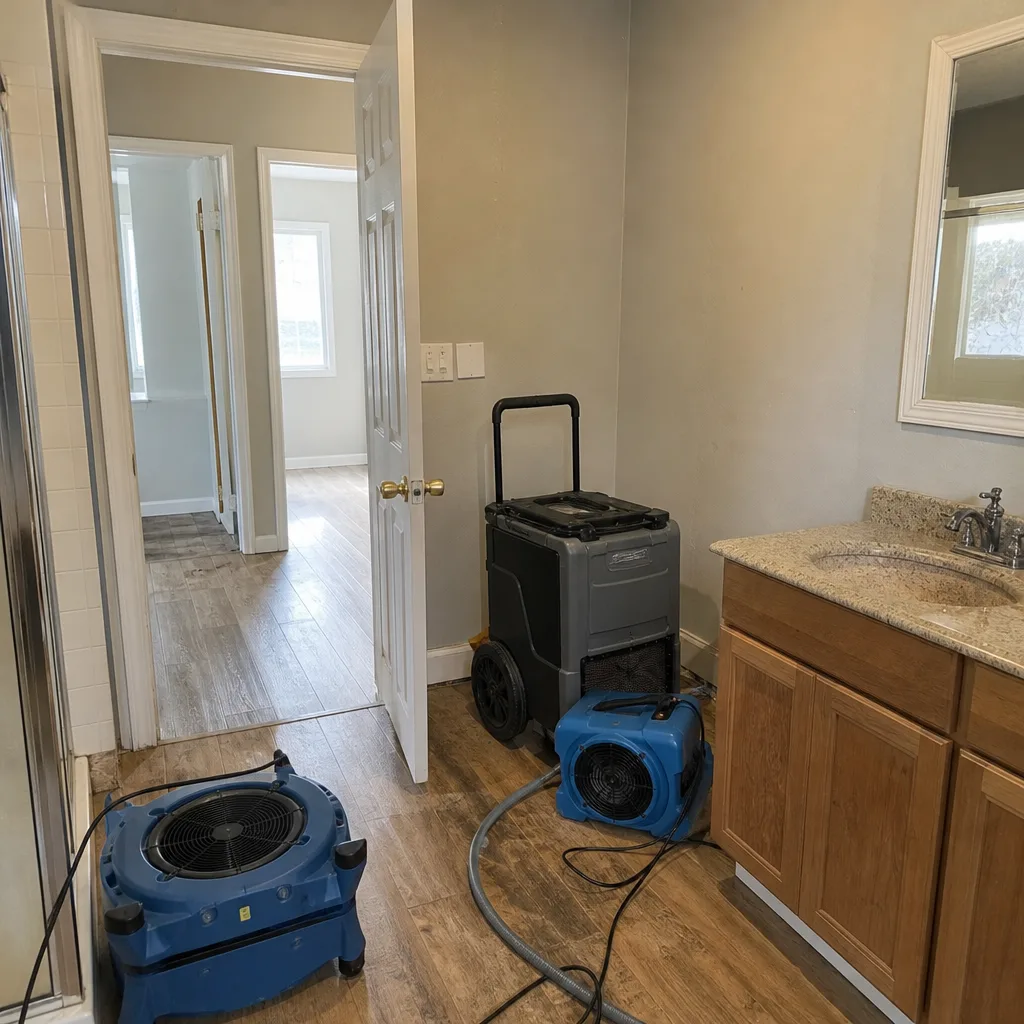
In our experience as a Fullerton restoration company, we deploy Dri-Eaz dehumidifiers, Phoenix air movers, and XPOWER air scrubbers from our own inventory. The Injectidry system sits on our shelf, ready for the wall cavity jobs that other companies quote as “full tear-out.” That equipment decision is not marketing. It is why we can restore water-damaged homes in Fullerton without needless demolition.
How to Verify Active vs. Lapsed IICRC Certification in Real Time
A logo on a website proves nothing. IICRC certification requires ongoing continuing education credits. A company that printed the logo in 2019 and let the credential lapse in 2023 is not IICRC-certified today, regardless of what their van wrap says. In Fullerton, we recommend a two-minute verification that any homeowner can perform before signing a work authorization.
Step-by-Step Verification
- Go to the IICRC website’s “Find a Pro” directory. Search by company name and zip code. If the company does not appear, they are not current.
- Ask for the technician’s individual certification number. IICRC credentials are held by individuals, not just companies. The person who supervises your job should have a current WRT (Water Damage Restoration Technician) or ASD (Applied Structural Drying) certification.
- Check the certification date. IICRC credentials expire. Ask to see the wallet card or the digital credential with a current date. A card that says 2021 is expired in 2026.
- Call the IICRC office if you are unsure. The organization verifies credentials by phone. It takes five minutes and eliminates the risk of trusting a lapsed badge.
- Check for professional association membership. RIA (Restoration Industry Association) membership and IFA affiliation are separate signals of ongoing professional development. They are not a substitute for IICRC certification, but they show the company is plugged into industry accountability networks.
A company that gets defensive when you ask to verify credentials is telling you something. We have never had a Fullerton homeowner regret the two minutes spent checking. We have had several tell us they walked away from a competitor when the verification turned up nothing.
What Documentation Practices Reveal About a Company’s Process
The most revealing difference between a professional restoration company and a performative one is invisible during the first phone call. It shows up in the paperwork. A professional operates like a clinical process: baselines are recorded before equipment placement, progress is measured daily, and the job ends with a clearance report that proves the structure is dry, not a text message saying “we pulled the machines.”
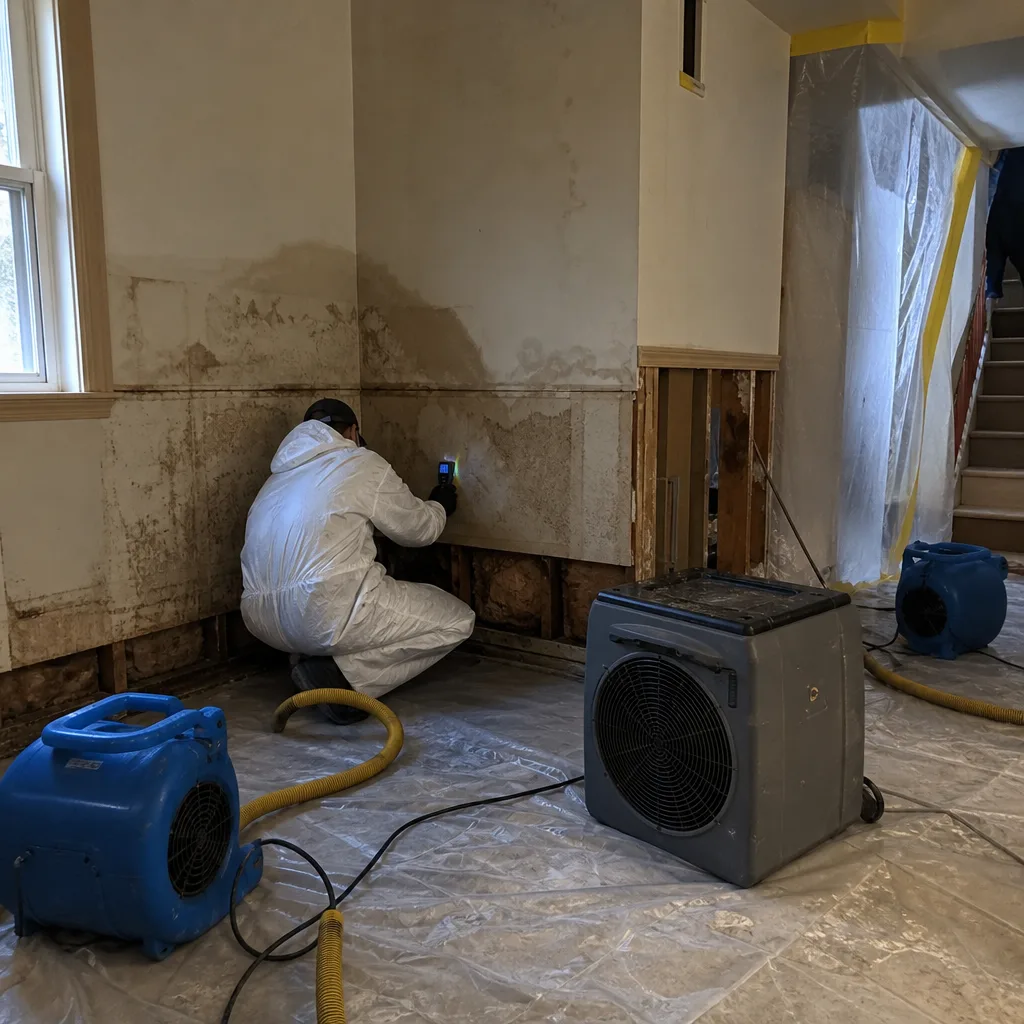
Drying logs are the core document. They record moisture readings at specific locations: wall cavities, subfloor, baseboards, ceiling. Each reading has a date, time, and the meter used. A professional company updates these daily. A company without logs is guessing.
Psychrometric readings measure the actual drying environment: temperature, relative humidity, and grains per pound of moisture in the air. They tell the technician whether the dehumidifiers are winning or the air is saturated. Without them, “it feels dry” is the only metric, and “it feels dry” is how mold gets a head start in a Fullerton wall cavity.
Clearance reports come at the end. A third-party or in-house hygienist confirms that moisture levels have returned to the normal range for Fullerton’s baseline building materials. The report becomes your permanent record. If you sell the home in five years, that report answers the buyer’s question about past water damage.
The documentation standard at our mold remediation work in Fullerton is the same: air samples before, containment during, clearance after. We do not consider a mold job complete until the lab results confirm the spore counts are normal. That is what “restored to standard” means. It is measurable.
Fullerton-Specific Factors: Housing Stock, Permits, and the 72-Hour Window
Fullerton is not a new-construction city. Drive through the Maple neighborhood or the areas around Downtown Fullerton, and you’ll see Craftsman bungalows, Spanish Revival homes, and mid-century ranch houses that have been standing since before the 1950s. Older housing stock changes restoration math. Plaster walls hold moisture differently than drywall. Original hardwood floors cup and warp on a different timeline than engineered planks. Wood-framed windows that have been repainted eight times hide water intrusion differently than modern vinyl frames.
Local permit relationships also matter. Water damage that reaches load-bearing framing or electrical systems may trigger a Fullerton building permit. A restoration company that has never worked with the Fullerton Building Division will slow your recovery while they figure out the process. One that has existing relationships with local inspectors can move the paperwork faster. Ask about the company’s recent Fullerton permit history. If the silence is long, that is your answer.
Proximity is a practical factor that brand guides ignore. The 72-hour window for preventing microbial growth does not start when you call. It starts when the water stopped. Every hour a crew spends driving from Riverside or Irvine is an hour your drywall is wicking moisture upward. A Fullerton-based operation can deploy equipment from local storage inside an hour. That is not a convenience. It is the difference between drying an exterior wall and replacing it.
Fullerton’s climate is relatively dry compared to coastal cities, which gives a false sense of security. Interior humidity trapped inside a wall cavity after a supply-line leak can exceed 80% even when outdoor humidity is 45%. The outside air does not save you. Only active dehumidification does.
Twelve Questions to Ask Before You Sign Anything
The work authorization is a contract. You have the right to ask questions before signing, and a professional company expects them. A defensive answer is a red flag in itself.
- Who will do the work: your employees or subcontractors? If subcontractors, get the subcontractor’s name and certification status in writing.
- Do you own your drying equipment or rent it? Owned equipment means continuity. Rented equipment means schedule pressure.
- What brands of dehumidifiers and air movers do you use? Dri-Eaz and Phoenix are commercial-grade. No-name units are not.
- Are your IICRC certifications current? Ask for the technician’s number and verify it on the IICRC website before they leave.
- Will you provide daily drying logs and final clearance documentation? If the answer is “we don’t do that,” you are hiring a cleanup crew, not a restoration firm.
- Have you worked on homes of my construction type in Fullerton? Plaster, old electrical, and original hardwood each require specific protocols.
- Will you handle my insurance claim documentation? Photo documentation and direct adjuster coordination are standard professional practice. If they balk, walk.
- What is your process if the structure is not dry by day three? A professional has a protocol. An amateur will improvise.
- Do you own an Injectidry system or equivalent? Targeted-injection drying saves walls and floors. If they have never heard of it, they are years behind.
- Can you provide a written scope before work begins? No written scope means no agreed endpoint. That is how surprise invoices happen.
- Who is accountable if the work fails? Get a name, not a company slogan.
- What local Fullerton permits have you pulled in the last year? A local restoration company with current permit history understands local code.
Insurance Navigation: Photo Documentation and Adjuster Coordination
Water damage claims are a documentation contest. The insurer’s adjuster sees photos, moisture readings, and a written scope. If your restoration company does not produce these documents, the adjuster estimates low, and you pay the difference out of pocket. A professional restoration company treats insurance documentation as part of the job, not an afterthought.
We photograph everything: the initial water line, the moisture meter readings on affected surfaces, the equipment placement, the daily drying log, and the final clearance readings. Each photo is timestamped and tied to the job file. We coordinate directly with adjusters, walking them through the scope and answering their questions in real time. That direct communication is what moves a claim from “pending” to “approved” without months of back-and-forth.
For fire damage restoration in Fullerton, the documentation burden is even heavier. Fire claims involve board-up, smoke mitigation, structural assessment, and content inventory. The adjuster needs a complete loss list and a defensible scope of work. Without it, you are negotiating against your own insurer with one hand tied. The restoration company that documents everything is your best advocate in that negotiation.
Common Mistakes to Avoid
- Hiring based on the first Google result without verification. The top result in Fullerton paid for that spot. It did not earn it through restoration outcomes. Verify credentials before you call.
- Assuming a franchise name guarantees quality. Franchise licensing is a business arrangement, not a certification. The local franchisee may be excellent or may be outsourcing your job to an uncredentialed crew.
- Signing a work authorization before seeing a written scope. Without a written scope, you have agreed to an undefined job with undefined costs. Always get the scope in writing first.
- Accepting “it’s dry” without a clearance report. Moisture hides in wall cavities and subfloors. If the company cannot produce psychrometric readings and a final clearance report, the job is not finished.
- Choosing the lowest bid on a water damage job. The lowest bid in Fullerton usually means rented equipment, uncertified labor, or a scope that ignores half the affected area. Restoration is not a place to shop for discounts.
- Waiting to call after discovering a supply line leak. The 72-hour window is not aspirational. Every hour matters. Call a restoration company the same day you discover the leak, even if the water seems “minor.”
- Letting a general contractor handle restoration. A remodeler is not a water damage specialist. The skills, equipment, and certification requirements are different. A general contractor who “does water damage too” is usually doing both poorly.
When to Call a Professional
Call a restoration company the day you discover a supply line leak, a water heater failure, a roof leak that has soaked into the ceiling, or any water event that affects more than a few square feet of flooring. Do not wait to see if it dries on its own. Wall cavities and subfloors do not air-dry in Fullerton’s climate, and the moisture you cannot see is the moisture that causes structural problems later. Call immediately for sewage backups, flooding, or any water that has contacted electrical systems. Mold odors, visible mold growth, and fire or smoke damage are also immediate calls. If you are in Fullerton, Mahogany Water Damage offers free estimates and can answer your questions without obligation. Call (855) 356-4970 and we will help you assess the situation.
Frequently Asked Questions
The best restoration company in Fullerton owns commercial-grade drying equipment, holds current IICRC certification, provides written scopes and documentation, and handles water, mold, and fire damage with its own employees rather than subcontractors. Verify credentials on the IICRC website and ask about equipment brands before you sign anything. Call (855) 356-4970 for a free assessment from our Fullerton team.
You need a restoration company because water damage requires industrial drying equipment, psychrometric monitoring, and certification in structural drying that general contractors typically do not have. A general contractor is appropriate for reconstruction after the structure is dry, not for the drying itself. In Fullerton, we see many jobs where a general contractor attempted to “dry it out” with box fans, and the homeowner ended up with mold remediation added to the scope.
A Fullerton-based restoration company can start mitigation the same day you call because the equipment is stored locally and the technicians are in the area. Our team at Mahogany Water Damage deploys owned Dri-Eaz and Phoenix drying systems to Fullerton homes daily. Call (855) 356-4970 for a same-day assessment.
Insurance coverage depends on the source of the water: sudden and accidental events like supply line breaks are typically covered, while gradual leaks and lack of maintenance may not be. A documented restoration process with photo evidence and daily drying logs gives your adjuster the information they need to process the claim fairly. We provide that documentation on every job.
IICRC certification means the technician has completed standardized training in water damage restoration, applied structural drying, or mold remediation and maintained that credential through continuing education. It is the restoration industry’s most recognized independent credential, and it is your assurance that the process will follow established standards rather than improvisation. Ask for a current certification number, not a logo on a website.
Mold on non-porous surfaces can sometimes be cleaned and treated, but mold that has penetrated drywall, insulation, or wood framing requires remediation because the growth extends inside the material. A professional mold assessment with air sampling determines the appropriate scope. Our mold remediation process in Fullerton follows IICRC standards for containment, removal, and clearance testing, which means you get a documented endpoint, not a guess.
Look for named equipment brands, current certification credentials, a physical Fullerton address or service area commitment, a documented process description, and a real phone number answered by a person. Websites that say “quality service” without naming equipment or credentials are generic marketing. Websites that name their drying systems and their certification status are run by companies that actually do the work.
The Bottom Line
Choosing a damage restoration company in Fullerton is not a brand loyalty exercise. It is a verification exercise. Owned equipment, current IICRC certification, written documentation, and direct accountability predict a good outcome far more reliably than a nationally recognized logo. Ask the twelve questions in this guide before you sign. Verify what they tell you. Then choose the company that can answer every question with specifics, not slogans. In Fullerton, the right choice is usually the equipment-forward local specialist who owns the tools, the credentials, and the responsibility for your outcome.
Written by the team at Mahogany Water Damage, serving Fullerton since 2011.
See the difference
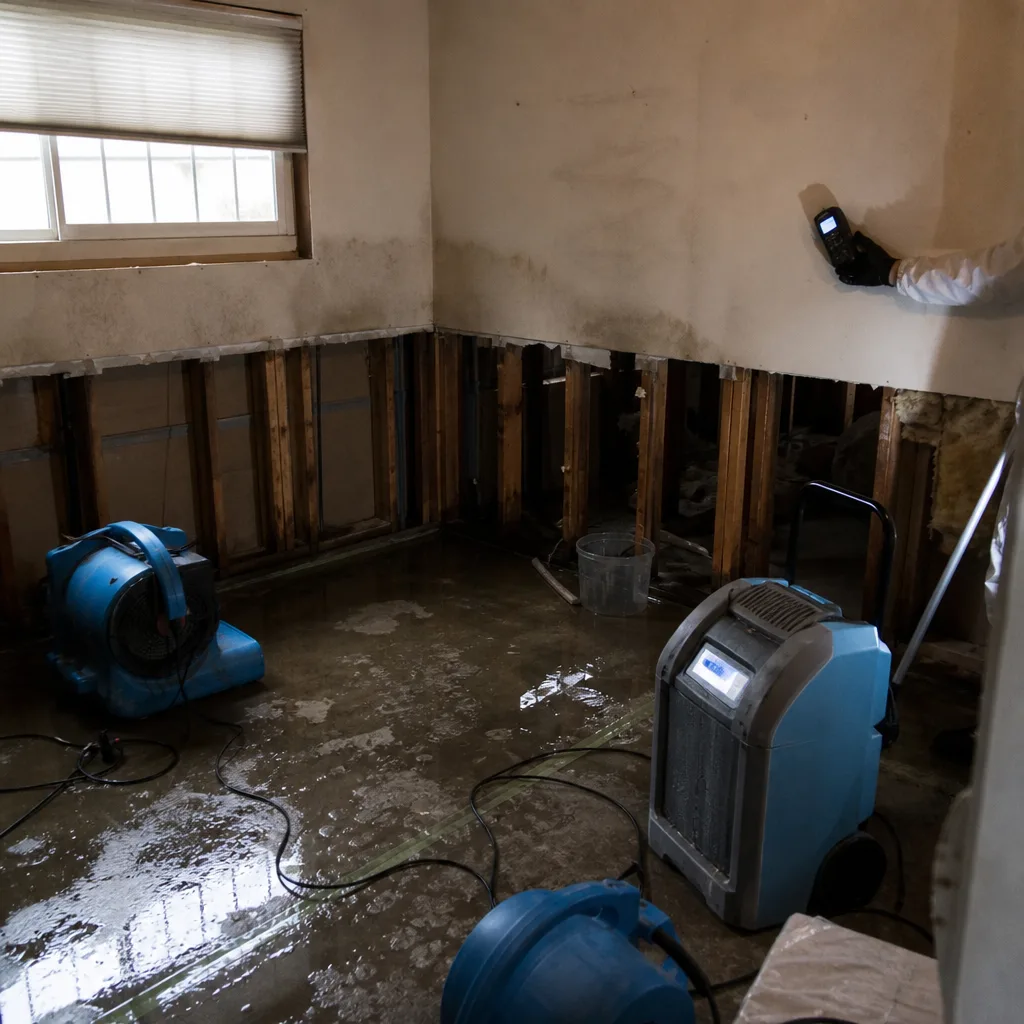 Before
 After
 Before
 After
 Before
 After