Last updated October 30, 2026
 Water damage drying
 Fire & smoke cleanup
 Mold remediation
 Storm response
 Sewage cleanup
 Reconstruction
Free visual inspection and a written scope of work before any mitigation begins - photos, moisture readings, and drying logs go in your claim file
The scope we write is the scope we bill. Anything new gets shown to you, in writing, before we touch it.
Get your free estimateDIY vs Professional Damage Restoration: The Fullerton Homeowner’s Decision Guide
Every year, Fullerton homeowners spend $200 on shop vacuums and box fans to address what looks like a minor leak, then spend $15,000 to $40,000 removing the mold that grew inside the wall cavity those fans couldn’t reach. This guide exists to stop that sequence before it starts. We’ll walk you through the actual decision points: how to classify the water you’re dealing with, what consumer equipment can and cannot physically accomplish, when a homeowner in Fullerton can reasonably handle cleanup alone, and when calling a certified team from the start is the only financially sound move. We’ll also cover what your insurance company expects to see, and what California law expects when you eventually sell.
Quick Answer
DIY damage restoration is only appropriate for clean water (Category 1) on non-porous surfaces where the affected area is fully dry within 24-48 hours. Any water that has touched building cavities, sewage, or been present longer than 48 hours requires professional-grade drying equipment and IICRC-certified process, because the moisture you can’t see is what creates mold you’ll pay to remove later.
Restoration work we handle
Table of Contents
- The IICRC Water Category System: Your Actual DIY Gate
- What Consumer Equipment Physically Cannot Do
- Fullerton Scenarios Where DIY Surface Cleanup Is Genuinely Acceptable
- The Expected Value Problem: What DIY Failure Actually Costs in Fullerton
- Insurance Documentation and California Disclosure Law
- What a Professional Restoration Actually Does Differently
- The Fullerton Homeowner’s Decision Checklist
- Common Mistakes to Avoid
The IICRC Water Category System: Your Actual DIY Gate
Most homeowners judge a water problem by how big the puddle is. That’s backwards. The IICRC classification system, which every legitimate restoration company uses, judges water by its contamination level and what it has touched. Size matters less than source.
Category 1: Clean Water. This is water from a sanitary source: a supply line, a faucet left running, a water heater tank that cracked but hasn’t mixed with anything else, rainwater that came straight through an open window. It’s safe to touch. If the affected material is non-porous (tile, sealed concrete, vinyl plank) and you can dry it fully within 24 to 48 hours, DIY is genuinely on the table. If that same Category 1 water soaks into drywall, carpet padding, or the interior of a wall cavity, it changes the math even though the water itself never changed category. Those materials hold moisture in ways a towel can’t fix.
Category 2: Gray Water. This is water with significant contamination: washing machine overflow, dishwasher discharge, toilet overflow without solid waste, sump pump failures. This water contains microorganisms and nutrients for them to feed on. DIY with this is a mistake. You’ll be cleaning surfaces while colonies establish themselves inside materials.
Category 3: Black Water. Sewage, floodwater from outside, any water containing pathogens, fecal matter, or chemical runoff. This is not a cleaning project. It’s a removal and disinfection project governed by containment protocols. No amount of bleach from a hardware store converts Category 3 into something safe for a homeowner to handle with rented tools. The materials affected often need to be cut out and disposed of under specific guidelines.
In Fullerton, we see a particular version of this problem after heavy winter rains. Older homes in neighborhoods near downtown, built in the 1940s and 1950s, often have slab foundations and older drain systems. When storm drains back up, the water that enters isn’t rain from the sky, it’s everything the drain carried. Homeowners who treat it like window rain end up with problems inside walls, under baseboards, and eventually behind cabinetry.
The category system matters because it determines the standard of care. Insurance adjusters use these categories when reviewing claims. Courts reference them in disputes. Your restoration company should be able to tell you, in plain language, what category you’re dealing with and why.
What Consumer Equipment Physically Cannot Do
This is where the physics matters. The tools you can buy or rent are designed to move air, not to remove water from materials and cavities. That distinction is the entire difference between drying and appearing to dry.
A box fan moves air across a surface. If that air is already humid (and in Fullerton, especially during summer months when relative humidity stays high, it usually is), you’re moving moisture around, not removing it from the structure. Evaporation stops when the air can’t hold more water. The surface feels dry because you’re touching the top millimeter, while the interior of the drywall, the wood framing, the carpet pad, and the sill plate underneath remain saturated.
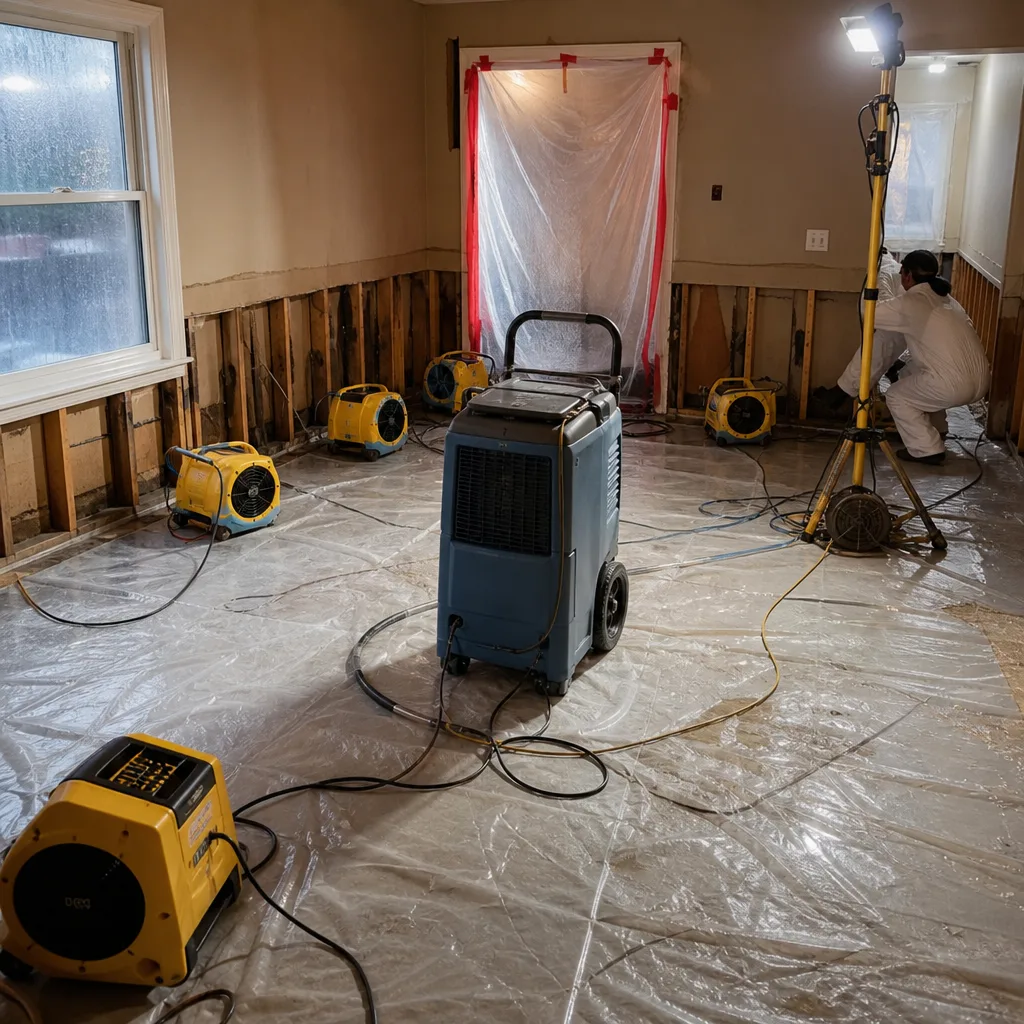
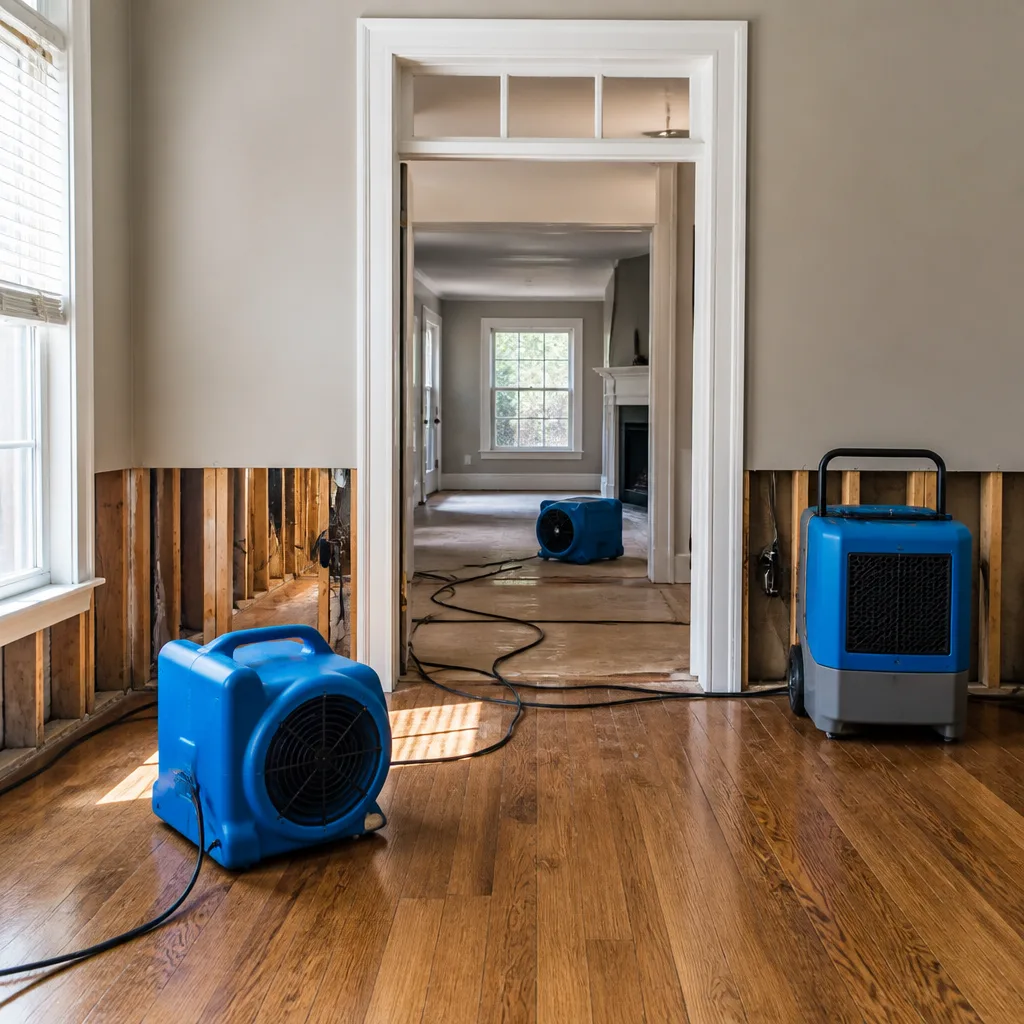
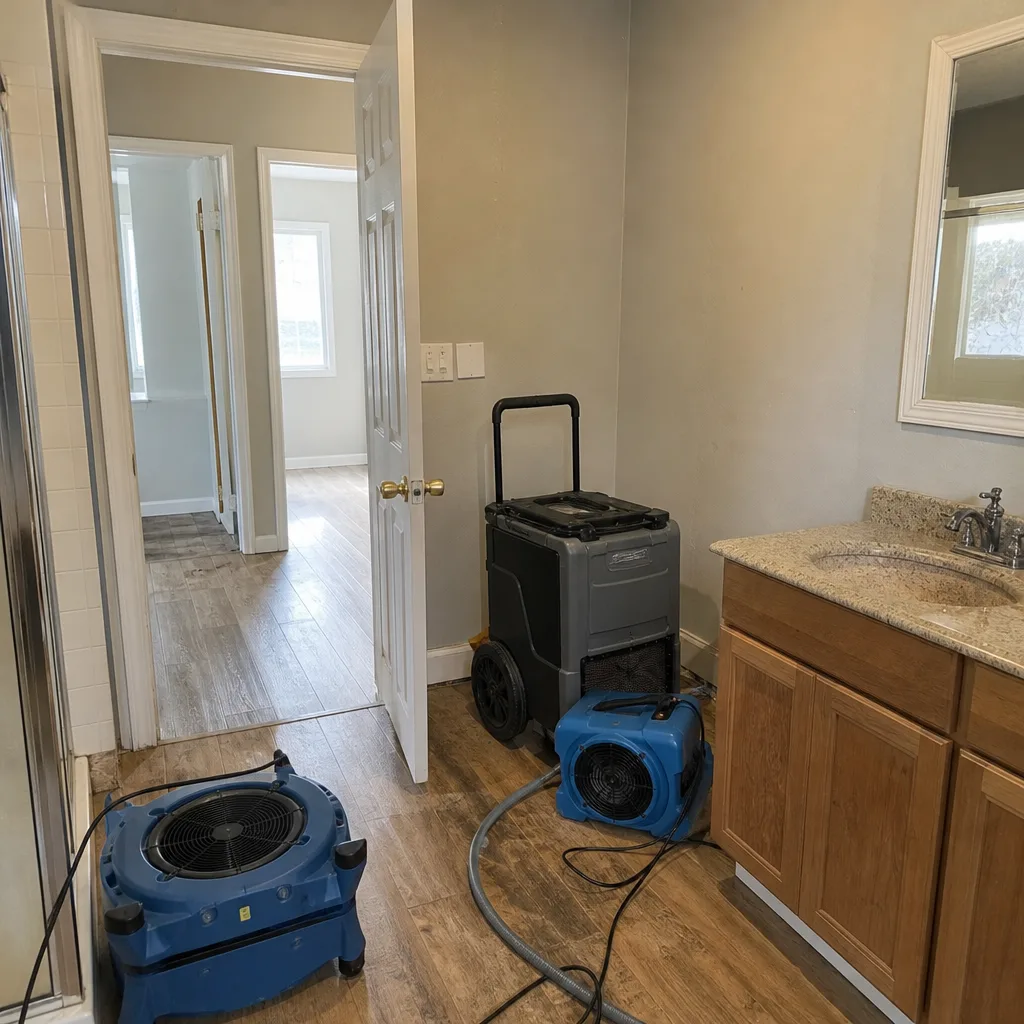
Professional drying operates on a different principle. Equipment like the Dri-Eaz and Phoenix systems we run creates a controlled environment: high-volume air movement combined with dehumidification that actually lowers vapor pressure in the room. When vapor pressure drops, moisture inside materials is drawn outward. That’s not a fan trick. That’s engineered drying.
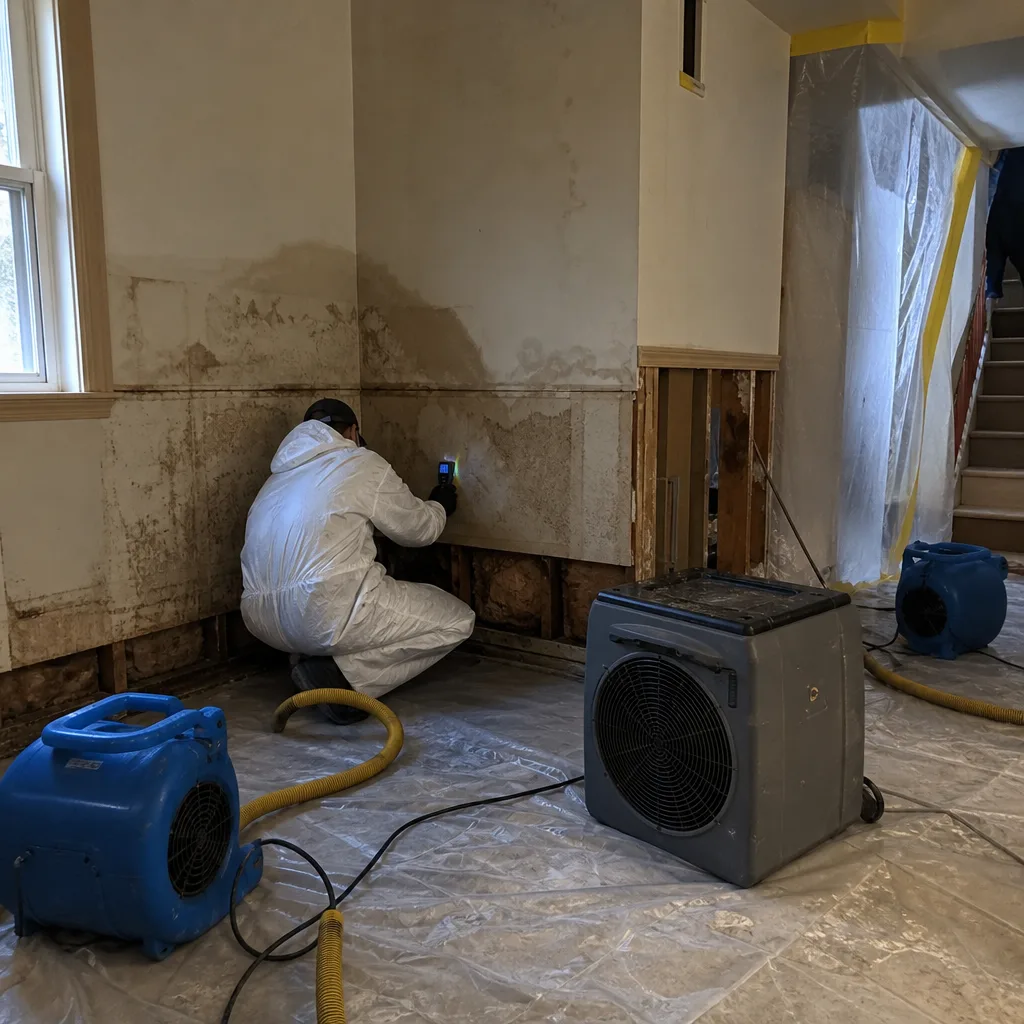
Then there’s the cavity problem. When water gets behind a wall, the insulation, the back side of the drywall, and the framing all hold moisture. No amount of air movement across the front of the wall pulls water out from behind it. This is where Injectidry targeted-injection drying matters. The system pushes dry air directly into wall cavities and under floors through small access points, drying the spaces that would otherwise be demolished or, worse, left wet. The alternative from a less equipped contractor is tear-out: cutting open the wall, pulling insulation, replacing sheetrock. Homeowners in Fullerton often don’t realize that a precise injection-drying approach can save the wall entirely. Dry smarter, demolish less isn’t a slogan. It’s a cost and disruption calculation.
The XPOWER and B-Air air movers we use on most jobs move a volume of air that consumer fans simply cannot match. That matters not because faster feels impressive, but because the drying timeline determines whether mold establishes. Mold has a 24 to 48 hour window. Professional equipment is designed to beat that window. Box fans are not.
Fullerton Scenarios Where DIY Surface Cleanup Is Genuinely Acceptable
Being honest about this matters. There are situations where a homeowner with basic tools and good judgment can handle cleanup without calling us, and a credible restoration company should say so. Here’s the actual list.
1. Small Category 1 spills on non-porous surfaces. A cup of water knocked onto tile. A supply line that dripped onto sealed concrete in the garage and you caught it the same day. Wipe it up, run a household dehumidifier if you have one, and monitor. This is cleanup, not restoration.
2. Overflow from an appliance you caught immediately and can fully see. If your washing machine leaked clean water onto a vinyl floor and you got to it within an hour, mop it thoroughly, pull the appliance out, dry underneath it, and verify the water didn’t wick under baseboards or into a wall. If it did, stop and reassess.
3. Rain through an open window onto a surface with no absorbent material nearby. The key variables: enclosed space, water volume, and what absorbed it. A puddle on tile that didn’t travel is manageable. A window leak that ran down inside the wall is not.
The common thread in every legitimate DIY situation: the water was clean, the surface was non-porous, the source was stopped, and you can see the entire affected area. The moment you lose any one of those four conditions, the job stops being cleanup and starts being restoration.
For Fullerton homeowners, climate matters here. Our marine-influenced Mediterranean climate means mild, mostly dry conditions for much of the year. But when the summer humidity settles in or the winter rains arrive, evaporation slows. A quick DIY dry that would work in El Paso in July will not work in Fullerton in January. Factor the season into your decision.
The Expected Value Problem: What DIY Failure Actually Costs in Fullerton
The argument for DIY is always upfront cost: why pay a restoration company when a shop vac is $80? Here’s the honest expected value math that almost nobody runs.
Let’s set up a realistic Fullerton scenario. A toilet supply line fails while you’re at work on a Tuesday. Water runs for hours. By the time you get home, there’s standing water across a bathroom floor, and it has seeped into the hallway carpet and the wall cavity shared between the bathroom and a bedroom.
The DIY path. You rent a carpet cleaner at Home Depot for $40, buy a box fan for $60, run them for three days, and decide things feel dry enough. You’re out about $250 including the time you took off work. The problem: the wall cavity never dried. The carpet pad at the edges never dried. The sill plate under the wall never dried. Within three to six weeks, you notice a smell in the bedroom. Six months later, a patch of discoloration appears at the baseboard line. Now the mold is established, and remediation requires cutting out drywall, treating framing, possibly replacing sections of carpet and pad, plus containment protocols if the affected area is large. In Fullerton, mold remediation of that scale typically runs from $4,000 to $12,000, depending on the extent of the hidden spread. If the mold has moved up the wall cavity or into the HVAC return nearby, the number climbs.
The professional path. You call a restoration company the same day. A technician classifies the water as Category 1 or 2 depending on the path it took, tests the materials with a moisture meter (which registers moisture deep inside materials, not just on the surface), sets up commercial drying equipment, monitors daily with documented readings, and provides a dry-standard report. The cost for a contained single-room event in Fullerton commonly runs $1,800 to $4,500. The walls get dried, not demolished. The carpet is saved or, if the pad is too far gone, decisively replaced.
The expected value calculation isn’t $250 versus $3,000. It’s $250 plus a very real probability of $7,000-$15,000 later, versus $3,000 now. The question isn’t what you spend today. It’s what you’re gambling tomorrow.
We’ve walked into Fullerton homes where that gamble was lost. The story is always some version of the same thing: the visible water was handled, the invisible water wasn’t, and the mold bill was five to forty times what the initial restoration would have cost.
Insurance Documentation and California Disclosure Law
Two forces shape this conversation beyond the immediate cleanup: your insurance policy and the State of California.
On the insurance side, what matters is documentation. When a homeowner does DIY restoration, the documentation typically consists of a receipt for a rented fan and perhaps some phone photos. When an adjuster reviews a water damage claim weeks later, they’re looking for professional drying logs: moisture readings taken before, during, and after drying, equipment placement records, a psychrometric chart showing the drying environment was actually controlled. Without that, the insurer has room to argue that the damage was not properly mitigated, that secondary damage from lack of drying isn’t covered, and that the claim should be denied or reduced. We coordinate directly with adjusters and provide the documentation that insurance companies recognize, because it follows the IICRC standard.
Then there’s California Civil Code § 1102, which requires sellers to disclose known material facts about a property. If you had water damage and did a DIY cleanup, and mold later shows up, you now have a disclosure obligation. If a buyer discovers undisclosed water damage or mold after closing in California, the legal exposure is serious: repair costs, remediation, and sometimes damages. Fullerton real estate moves fast, and homes in established neighborhoods from the 1950s and 1960s have plenty of buyers. None of them want to inherit a mold problem. The disclosure issue becomes particularly thorny if the damage occurred within the years immediately preceding a sale, when memory and records are most relevant.
The practical takeaway: a professional restoration with documented drying creates a record. That record protects your insurance claim today and your legal standing when you sell. A shop vac receipt does neither.
What a Professional Restoration Actually Does Differently
If you’ve never watched a restoration crew work, the difference is instructive. Here’s the sequence, because understanding the process should inform the DIY decision.
1. Assessment and classification. The first visit isn’t about equipment. It’s about classification: water category, affected materials, migration path (where the water traveled, including inside cavities), and the drying environment. A moisture meter and thermal imaging are standard tools. In our crews’ hands, this is where the scope gets defined.
2. Extraction. Standing water comes out before drying begins. Professional extraction tools remove water that a shop vac leaves behind, especially from carpet and pad. The difference in retained water is substantial.
3. Containment and controlled drying. This is where the equipment-forward approach separates results from appearance. Dri-Eaz and Phoenix dehumidifiers lower the vapor pressure in the room. Air movers circulate dry air across surfaces. If water is trapped in cavities, an Injectidry system pushes dry air directly into the spaces the surface can’t reach. Each day, moisture readings document the downward trend until materials reach dry standard, meaning the moisture content matches the dry standard for that material type in that environment. Restored to standard means something measurable, not just “feels dry.”
4. Documentation. Daily logs, photo documentation, drying charts. This is what your adjuster needs and what your future home sale might require.
5. Final verification. Equipment doesn’t leave until the numbers say dry. Not until it looks dry. Until it is dry.
For mold and fire work, the process differs in specifics but shares the same principle: assessed, contained, treated, verified. One of the reasons homeowners hire us across the full trilogy is that water, mold remediation in Fullerton, and fire damage restoration in Fullerton often overlap. Water that isn’t dried becomes mold. A fire that was extinguished leaves water damage from the suppression effort. Having one team handle the sequence, start to finish, removes the handoff gaps where damage compounds and accountability disappears.
The Fullerton Homeowner’s Decision Checklist
Here’s a decision sequence you can run in five minutes, specific enough to be useful.
- Identify the water source and category. Clean supply water? Or did it come from a drain, appliance that handles waste, toilet, or outside? If it’s anything but clean water, stop considering DIY.
- Determine what the water touched. Tile, sealed concrete, and vinyl are one thing. Drywall, carpet, hardwood, engineered wood, insulation, and wall cavities are another. If absorbent materials or enclosed spaces are wet, DIY is a gamble.
- Measure the timeline. If the water has been present for more than 48 hours, mold risk is already elevated regardless of category. If you can’t confirm when it started, assume the window has passed.
- Assess whether you can see everything. Water travels. If the source is near a wall, under cabinetry, or adjacent to another room, you cannot see the full extent without moisture testing.
- Check the season and indoor conditions. Fullerton’s dampest months are December through March. High indoor humidity in summer also slows evaporation. If the air is humid, your fans are fighting the atmosphere.
- Run the honest cost comparison. Estimate the professional restoration cost, then estimate the cost of professional remediation after DIY failure. Multiply the second number by the probability that your DIY drying missed something hidden. Compare that to the professional number. The math usually answers the question.
Common Mistakes to Avoid
- Treating all water as the same. Fullerton homeowners frequently apply the same cleanup approach to a clean supply line leak and a washing machine overflow. The contamination level is different, which makes the risk profile different. Classify first.
- Relying on surface touch as the drying test. A wall feels dry to the palm long before the interior of the drywall and the framing behind it are dry. Moisture meters measure the inside. Fingers measure the outside.
- Putting furniture back before the space is dry. Even in a proper professional drying, replacing a couch or a bookshelf against a wall that’s still releasing moisture creates a micro environment that stays damp. In a DIY context, it’s worse.
- Skipping documentation “because it was small.” You can’t know today whether an adjuster will ask for drying logs or a future buyer’s inspector will flag a moisture issue. The time to document is during the event, not after.
- Believing bleach solves mold. Bleach kills surface organisms but does not address the colony inside porous materials, does not remove dead spores (which are still allergenic), and does not fix the moisture source. Fullerton homeowners sometimes spend a weekend scrubbing with bleach and feeling productive while the actual problem grows in the wall.
- Waiting to see if the smell goes away. A musty odor is evidence of active biological growth. It does not resolve on its own. By the time you can smell it, the problem is established.
- Hiring a generalist handyman because the price is lower. Fullerton has no shortage of people willing to “take a look.” Restoration is a specialty with specific standards, specific equipment, and specific documentation requirements. A handyman with a wet vac is not a restoration contractor.
When to Call a Professional
Call a professional the day you discover any of these: water from a contaminated source, water that has been present for more than 48 hours, water that entered walls or cavities, any visible mold growth larger than a small patch on a non-porous surface that you can fully contain and remove with the material intact, any fire damage beyond a contained cooking incident, or any water event where you’ll be filing an insurance claim. The threshold isn’t the size of the puddle. It’s the category, the materials, and the timeline. Mahogany Water Damage offers free estimates in Fullerton. Call (855) 356-4970 and we’ll assess the situation, classify the water, and give you a straight answer about whether this is a DIY cleanup or a professional restoration. We’ll also tell you if it’s genuinely a DIY job, because part of being a credible contractor in this trade is saying when you’re not needed. And if you’re deep in a water problem right now, our water damage restoration in Fullerton page covers what happens next.
See the difference
 Before
 After
 Before
 After
 Before
 After
Frequently Asked Questions
You can, but whether it works depends on the water category, the materials affected, and the indoor humidity. Consumer dehumidifiers and fans move air but don’t create the low vapor pressure needed to pull moisture from inside drywall, framing, and cavities. For a small clean-water spill on tile caught immediately, yes. For anything that soaked into absorbent materials or walls in a Fullerton home, probably not.
Mold can establish within 24 to 48 hours under the right conditions, which is why the professional standard is to get affected materials to dry standard within that window. The clock starts when the water entered the material, not when you discovered it. If you’re past the 48-hour mark, call (855) 356-4970 for an assessment rather than gambling another day on fans.
Most Fullerton homeowners policies cover sudden and accidental water damage, such as a burst supply line or an appliance failure. Coverage typically depends on the cause, and insurers expect professional mitigation with documented drying. Our documentation process is built around what adjusters recognize, and we coordinate with them directly. Your policy language and deductible determine what you’ll pay out of pocket.
Water damage restoration is the emergency response: extraction, drying, and returning materials to dry standard before mold establishes. Mold remediation is the removal and treatment of established mold growth, which requires containment, specialized cleaning, and often removal of affected materials. When we handle both under one roof, there’s no gap between the drying crew and the remediation crew where communication breaks down.
Small patches of mold on non-porous surfaces, like tile or glass, can be cleaned with household products if you address the moisture source. Mold on drywall, wood, or anything porous means the organism has penetrated the material, and removing it safely requires containment and proper disposal. Disturbing mold without containment spreads spores through the air and often makes the problem larger than it was.
A contained single-room clean-water event in Fullerton typically runs $1,800 to $4,500 for full professional drying with documentation. Larger events, contaminated water, and situations requiring injection drying or selective demolition run higher. The honest comparison isn’t between $2,800 and $250 in DIY supplies. It’s between $2,800 now and the real probability of a $7,000 to $15,000 mold remediation later. Call (855) 356-4970 for a specific quote.
Yes, under California Civil Code § 1102, sellers must disclose known material facts including water damage and any mold history. Professional restoration creates the documentation that demonstrates the issue was properly resolved. DIY cleanup, even if you believe it was successful, leaves you in a position where you’re disclosing an incident with no professional record to show it was handled to standard; browse more guides & resources on protecting your property value.
The Bottom Line
The DIY-versus-professional decision in damage restoration isn’t about saving money. It’s about correctly classifying the water source and affected materials, because the two variables that make DIY catastrophically expensive, water category and hidden moisture, are both invisible to the untrained eye. In Fullerton, where older homes near downtown meet seasonal humidity and winter rains, the margin for error narrows. Clean water on tile, caught immediately, fully visible: go ahead. Anything else: the expected value math points one direction. A free assessment costs you a phone call. A missed wall cavity costs you a mold remediation. You’re a homeowner in Fullerton, not a moisture scientist. That’s not a shortcoming. It’s just the reason professionals exist.
Written by the team at Mahogany Water Damage, serving Fullerton since 2011. Our Mahogany Water Damage home page has more about how we work.