
Last updated October 30, 2026
 Water damage drying
 Fire & smoke cleanup
 Mold remediation
 Storm response
 Sewage cleanup
 Reconstruction
Free visual inspection and a written scope of work before any mitigation begins - photos, moisture readings, and drying logs go in your claim file
The scope we write is the scope we bill. Anything new gets shown to you, in writing, before we touch it.
Get your free estimateDamage Restoration Cost Breakdown: The Fullerton Homeowner’s Reference for 2026
Every year, Fullerton homeowners write checks for restoration work that should have cost 30 to 40 percent less. Not because contractors overcharged them, but because nobody explained how the pricing structure actually works before the emergency hit. This guide breaks down what drives restoration costs in Fullerton specifically, from the age of your stucco to the category of water in your living room, and points you to damage restoration warning signs every Fullerton homeowner should know. By the time you finish reading, you’ll know exactly what belongs on a legitimate invoice and what doesn’t.
Quick Answer
Water damage restoration in Fullerton typically runs between $3.50 and $8.00 per square foot for Category 1 clean water, $5.50 to $12.00 per square foot for Category 2 grey water, and $9.00 to $22.00 per square foot for Category 3 sewage contamination. Mold remediation generally falls between $1,800 and $7,500 depending on affected area and materials involved. Fire damage restoration is the widest range of all, starting around $4,000 for minor kitchen fires and exceeding $40,000 for structural rebuilds. The single biggest variable isn’t the damage itself. It’s the number of hours between the incident and the start of professional drying.
Restoration work we handle
Table of Contents
- The Real Cost Structure: Square Footage, Material Category, and Equipment Time
- Water Categories Explained: What Category 1, 2, and 3 Actually Cost in Fullerton
- Equipment Line Items on a Professional Invoice: What Each Piece Does and What It Should Cost
- The Insurance Scoping Gap: What Adjusters Approve vs. What a Compliant Scope Requires
- Fullerton-Specific Cost Escalators: Stucco Cavities, Asbestos Testing, and City Inspection Fees
- How to Read an Itemized Restoration Invoice: Legitimate Detail vs. Billing Fog
- A Tiered Price Breakdown by Damage Type for Fullerton Homes
- Why Equipment Quality Changes the Final Price: Rental Units vs. Commercial-Grade Systems
The Real Cost Structure: Square Footage, Material Category, and Equipment Time
Restoration pricing looks mysterious from the outside, but the underlying structure is straightforward once you see it. Every legitimate estimate in Fullerton is built on three interacting variables. The first is affected square footage, which almost always exceeds what you can see. Water travels under baseboards, through wall cavities, and across subfloor joists before it ever pools where you’re standing. The second is material category. Drywall, hardwood, carpet pad, and plaster each carry different drying and replacement costs. The third, and most misunderstood, is equipment deployment time.
Here’s how the math works in practice. A 400-square-foot living room with Category 1 water from a supply line break might need four air movers, two dehumidifiers, and three days of drying. That’s roughly $1,600 to $2,200 in equipment and monitoring alone. The same room with Category 3 sewage backup requires containment, disposal of contaminated materials, sanitization, and often partial reconstruction. That pushes the same 400 square feet to $8,000 or more. Same room, same size, completely different invoice because the material category and equipment protocols changed.
Every 24 hours of delay before drying starts adds a cost multiplier. Water that sits for one day soaks into drywall and wicks upward. Water that sits for four days reaches framing, insulation, and often the subfloor. That’s not contractor scare talk. It’s the physics of capillary action and the biology of mold germination, which begins at the 24-to-48-hour mark in Fullerton’s warm climate. Our work on Water Damage Restoration in Fullerton starts with an assessment that maps how far the water has actually traveled, because what you can’t see is where the real cost lives.
What Drives the Final Number
- Affected square footage including hidden cavities, not just visible surface area
- Water category determined by source and contamination level
- Material types affected including flooring, drywall, insulation, and structural lumber
- Equipment count and duration calculated by cubic feet of affected air and surface area
- Containment requirements for Category 2 and 3 jobs, which add labor and materials
- Reconstruction scope for anything that cannot be dried and must be replaced
Water Categories Explained: What Category 1, 2, and 3 Actually Cost in Fullerton
The IICRC water category system is the foundation of restoration pricing, and it’s the first thing your adjuster will reference when reviewing your claim. Category 1 comes from a sanitary source: a supply line, a faucet left running, or a water heater that leaked clean water. Category 2 contains significant contamination: dishwasher discharge, washing machine overflow, or clean water that sat long enough to pick up bacteria. Category 3 is grossly contaminated: sewage, floodwater from outside, or any water that has been in contact with fecal matter or pathogens.
In Fullerton, where many homes were built between the 1950s and 1970s, the category matters even more than in newer construction. Older homes often have plaster walls over wood lath, which behaves differently than modern drywall. Plaster can sometimes be saved after Category 1 exposure if drying starts immediately. It almost always requires removal after Category 2 or 3, because the porous lath behind it holds contamination that drying equipment can’t reach.
| Water Category | Typical Fullerton Cost per Square Foot | Drying Time | Typical Scope |
|---|---|---|---|
| Category 1 (Clean) | $3.50 – $8.00 | 3-5 days | Extraction, drying equipment, monitoring, minor repairs |
| Category 2 (Grey) | $5.50 – $12.00 | 4-7 days | Containment, antimicrobial treatment, some material removal |
| Category 3 (Sewage) | $9.00 – $22.00 | 7-14+ days | Full containment, disposal, sanitization, reconstruction |
One point that surprises Fullerton homeowners: a Category 1 water loss left untreated for 48 hours often gets reclassified as Category 2. The water itself hasn’t changed, but the environment it created has. Bacteria multiply, materials degrade, and the scope of work expands. That’s why response time is a pricing factor, not just a convenience factor. We start every Mold Remediation in Fullerton job by determining whether water exposure has already progressed to the point where remediation protocols are required alongside drying.
Equipment Line Items on a Professional Invoice: What Each Piece Does and What It Should Cost
A legitimate restoration invoice itemizes equipment by type, count, and days deployed. Vague billing like “drying services” without a breakdown is a red flag. Here’s what you should see, what each piece actually does, and what daily rates look like in the Fullerton market for 2026.
- Extraction unit ($150-$350 per day): Removes standing water. Truck-mounted units pull water faster than portable units, which matters when the water is deep or spread across a large area.
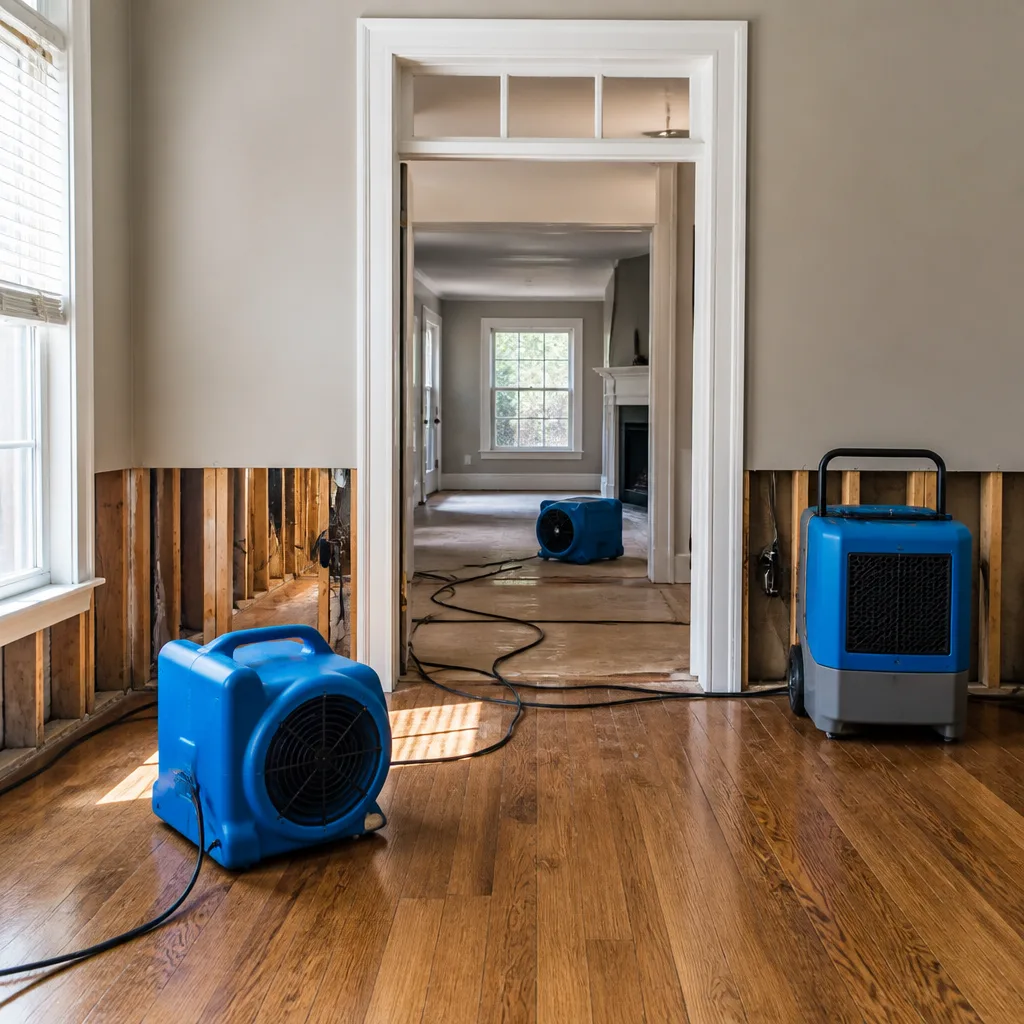
- Air mover ($35-$60 per day per unit): Creates high-velocity airflow across wet surfaces to accelerate evaporation. A 400-square-foot room typically needs 4 to 8 units.
- Dehumidifier ($90-$160 per day per unit): Pulls moisture from the air so it doesn’t re-condense on surfaces or get absorbed by building materials. Commercial dehumidifiers process 100 to 200 pints daily.
- Air scrubber ($120-$200 per day per unit): HEPA filtration that removes airborne particles, including mold spores released during demolition.
- Containment barrier ($1.50-$3.00 per linear foot): Plastic sheeting and negative air pressure to isolate contaminated areas from the rest of the house.
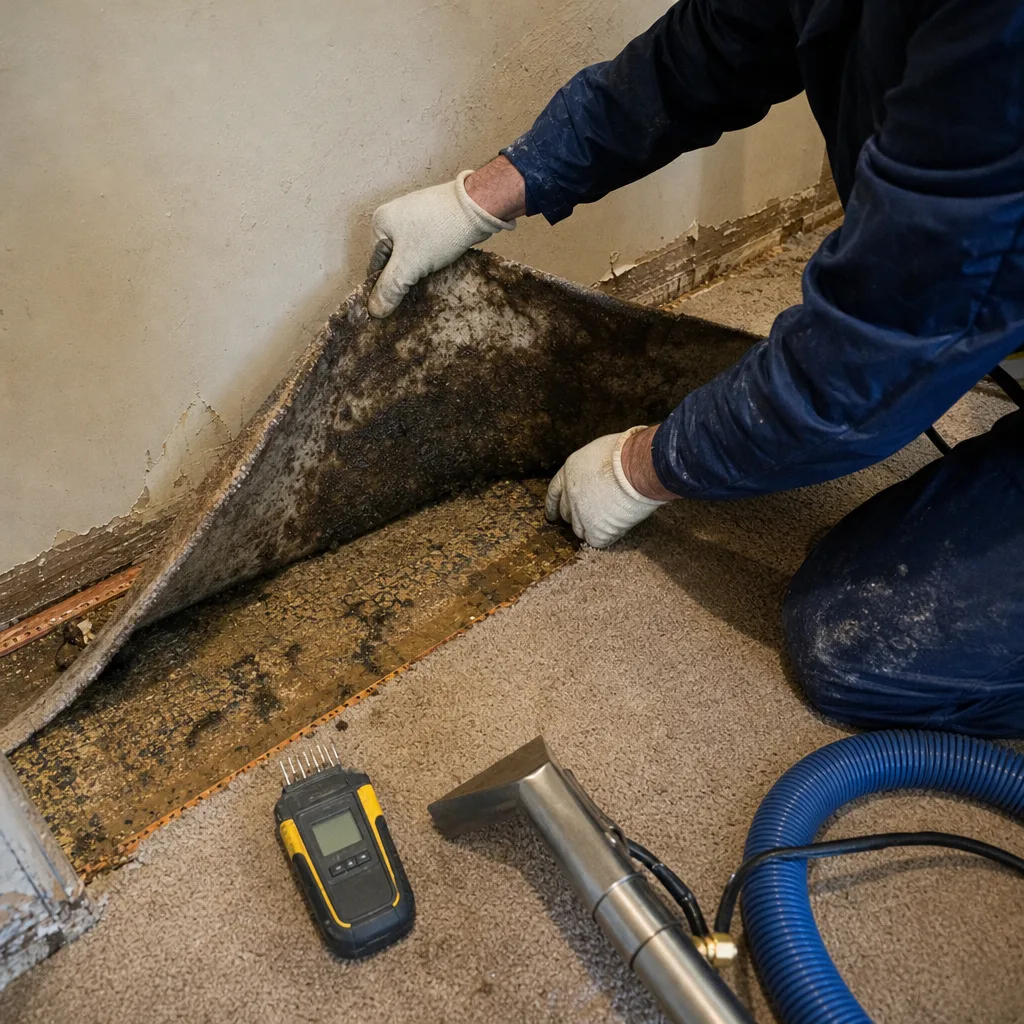
- Moisture monitoring ($75-$150 per visit): Daily readings with moisture meters to track drying progress and confirm the structure has reached a restored standard.
We run Dri-Eaz and Phoenix commercial systems on every job, which is a meaningful distinction. Rental-grade equipment from a big-box store dries at a fraction of the capacity. A residential dehumidifier might pull 30 pints per day. A commercial Dri-Eaz unit pulls 130 to 200. The daily rate is higher, but the job finishes in days instead of weeks, and fewer days of equipment deployment often means a lower total invoice. Plus, the materials get dry before mold takes hold. The math works in your favor when the equipment is actually matched to the job.
The Insurance Scoping Gap: What Adjusters Approve vs. What a Compliant Scope Requires
Insurance adjusters write scopes based on what they can see in photos and what standard pricing software says the job should cost. Restoration contractors write scopes based on what they find when they open walls and pull back carpet. These two documents almost never match on the first pass, and the gap is where Fullerton homeowners get stuck.
Here’s how the gap typically appears. An adjuster approves $4,200 for a kitchen water loss: extraction, four air movers, two dehumidifiers, three days of drying, and repainting. The contractor arrives, pulls the toe kick, and finds water has wicked under the cabinets and into the drywall behind them. The cabinets need removal and reset. The drywall needs a flood cut. The subfloor needs another two days of drying. The compliant scope is now $8,700. The adjuster’s first-pass number was never wrong. It was just written before the hidden damage was visible.
This is why documentation matters more than negotiation. A contractor who photographs every step, logs daily moisture readings, and provides written scope changes with justification will get the supplemental approval. A contractor who just bills extra at the end without documentation will get denied, and you’ll be left holding the difference. The gap between first-pass approval and final claim payment in Fullerton typically runs 30 to 60 percent on water jobs, and 50 to 100 percent on fire jobs, because fire damage hides inside wall cavities and above ceilings in ways that photographs can’t capture.
- File immediately. Photograph everything before any work begins.
- Request a detailed itemized estimate from your restoration contractor before demolition starts.
- Expect a supplement. The first adjuster scope is a starting point, not a final number.
- Require photo documentation of every discovery that expands the scope.
- Ask for written justification for every line item added after the initial scope.
Fullerton-Specific Cost Escalators: Stucco Cavities, Asbestos Testing, and City Inspection Fees
Fullerton has cost factors that a generic national pricing guide won’t mention. The first is stucco construction. A significant portion of Fullerton’s housing stock dates from the post-war building boom, when stucco over wood frame was the standard. Stucco is excellent at trapping moisture behind it. Water that gets into a wall cavity behind stucco can’t evaporate outward the way it can with siding or brick. That means cavity drying is mandatory, not optional, and cavity drying requires specialized equipment and more days of monitoring.
The second factor is asbestos. Homes built before 1980 in Fullerton frequently contain asbestos in flooring adhesive, popcorn ceilings, drywall compound, and insulation. When restoration requires demolition of these materials, California law requires testing before removal. Asbestos testing adds $300 to $800 to a job before work even starts, and if asbestos is present, abatement adds thousands more and requires a licensed abatement contractor. A restoration company that skips testing is cutting a corner that can cost you far more in fines and health consequences than the test itself.
The third factor is city permitting, which ties directly into damage restoration permits, codes & inspections in CA. Fullerton requires permits for structural repairs, electrical work, and plumbing alterations that result from restoration. Permit fees vary by scope but typically run $150 to $800, and inspections add time to the schedule. Some contractors quote work without permits and tell you it’s fine. It’s not fine. Unpermitted work creates disclosure problems when you sell the home and gives your insurance company grounds to deny future claims related to that area of the house.
We handle Fire Damage Restoration in Fullerton with these local requirements built into the scope from day one. The cost is honest up front, and the work passes inspection the first time because it was designed to.
How to Read an Itemized Restoration Invoice: Legitimate Detail vs. Billing Fog
There’s a difference between a detailed invoice and a real one. A real invoice tells you what was done, where it was done, how long it took, what equipment was used, and what each piece cost. Billing fog looks busy without actually telling you anything you could verify.
What a Legitimate Invoice Includes
- Line items by room: “Kitchen floor extraction, 220 sq ft” not “General extraction”
- Equipment counts and days: “4 air movers, 3 days, $45/day each” not “Drying equipment rental”
- Material quantities with units: “Drywall replacement, 6 sheets, 4×8, 5/8-inch” not “Drywall repair”
- Labor hours by task: “Demolition and disposal, 6.5 hours, 2 technicians” not “Labor”
- Daily drying logs showing moisture readings and drying targets
- Photo documentation referenced by room and date
Red Flags That Should Make You Ask Questions
- “Labor and materials” as a single line item with no breakdown
- Equipment charges with no day count or per-unit pricing
- Demolition charges without disposal fees listed separately
- Antimicrobial charges without specifying the product used
- No photo log or moisture readings attached to the invoice
- Charges for supervision, project management, or administration on top of labor
An invoice you can audit is an invoice you can trust. If a contractor won’t give you a detailed breakdown before work starts, get it in writing that you’ll receive one before final payment. In our experience, the contractors who resist itemization are the same ones who resist IICRC process standards and equipment documentation.
A Tiered Price Breakdown by Damage Type for Fullerton Homes
Here’s what Fullerton homeowners should expect to pay in 2026, broken down by damage type and severity tier. These ranges assume professional restoration with commercial-grade equipment and IICRC-certified process. The cheapest bids you’ll see will come in below these ranges. That’s not a savings opportunity. That’s a scope reduction you haven’t been told about yet.
Tier 1: Minor Water Damage (Single Room, Category 1)
$1,200 to $3,500. A supply line leak under a bathroom sink that was caught within hours. This covers extraction, two to four air movers, one to two dehumidifiers, two to three days of drying, and minor cosmetic repairs. No demolition beyond a small drywall patch. No containment required.
Tier 2: Moderate Water Damage (Multiple Rooms, Category 1 or 2)
$4,000 to $12,000. A water heater failure in the garage that flooded into a hallway and bedroom, or a dishwasher leak that sat overnight. This includes containment, wall cavity drying, some drywall removal and replacement, pad and carpet replacement in affected areas, and five to seven days of equipment deployment.
Tier 3: Severe Water Damage (Category 3 or Whole-Floor Exposure)
$12,000 to $35,000. Sewage backup, floodwater intrusion, or a slab leak that went undetected for weeks. Full containment, disposal of contaminated materials, sanitization, subfloor drying or replacement, cabinet removal and reset, and reconstruction of affected rooms. This is a two-to-four-week project.
Tier 4: Mold Remediation (Contained Area)
$1,800 to $7,500. Mold behind a bathroom wall, under a kitchen sink, or in a closet that stayed damp after a leak. This includes containment, HEPA air scrubbing, removal of affected materials, antimicrobial treatment, and verification testing. Larger areas or mold in HVAC systems push costs higher.
Tier 5: Fire Damage (Room-and-Contents)
$4,000 to $40,000+. A kitchen grease fire with smoke damage throughout, or an electrical fire in a bedroom. This includes board-up, soot removal, odor control, content cleaning, structural repairs, and often full repainting. The range is wide because fire damage is unpredictable: what looks like a small fire can have smoke that reached every room through the HVAC system.
These figures are starting points, not guarantees. The only way to get an accurate number for your specific Fullerton home is to have an assessment done with moisture meters, thermal imaging where applicable, and a visual inspection of hidden spaces. That’s what we do on every estimate visit, which is free for Fullerton homeowners.
Why Equipment Quality Changes the Final Price: Rental Units vs. Commercial-Grade Systems
Here’s a counterintuitive fact: the cheapest equipment on a restoration job often produces the most expensive invoice. A contractor who shows up with consumer-grade rental equipment from a hardware store will charge lower daily rates but need more days. More days means more labor, more monitoring, more disruption, and a higher probability that mold takes hold before drying completes. A contractor with commercial Dri-Eaz and Phoenix systems charges more per day but finishes faster and reaches a true dry standard the first time.
The distinction matters even more with specialized drying technology. Injectidry targeted injection drying is the difference between saving a wall cavity and demolishing it. When water gets behind tile, under cabinets, or inside a wall cavity, conventional drying equipment can’t reach it. The standard approach is demolition: tear out the tile, remove the drywall, replace it all. Injectidry pushes dry air directly into the cavity through small access points, drying the space without destroying the surface. On a Fullerton job where water migrated under a tile floor after a slab leak, this technology can save $4,000 to $8,000 in tile replacement costs alone, plus the disruption of a floor tear-out.
The equipment brand on the truck is not a vanity detail. Dri-Eaz, Phoenix, XPOWER, and B-Air units are engineered for restoration work specifically, with CFM ratings and pint capacities that match professional drying protocols. They’re owned by the contractor, calibrated regularly, and matched to the cubic footage of the affected space. A rented unit from a home improvement store is designed for basement dampness, not structural drying after a Category 2 event. The daily rate difference looks small on paper. The total invoice difference is not.
Our approach on every job is to dry smarter and demolish less. That’s not marketing language. It’s a measurable difference in scope that shows up on your invoice as money you didn’t spend on reconstruction you didn’t need. Our Mahogany Water Damage home page outlines the full equipment fleet and process standards we deploy on every Fullerton job.
Common Mistakes to Avoid
- Waiting to call because the water stopped spreading. The water you can see is not the water that’s causing the damage. What’s in the walls and under the floor keeps working long after the visible puddle is gone. Every day of delay in Fullerton’s climate is a measurable cost increase.
- Accepting a vague estimate without line items. “Water damage repair: $6,500” is not an estimate. It’s a guess. Demand equipment counts, material quantities, labor hours, and room-by-room scope. If it’s not itemized, you can’t audit it, and if you can’t audit it, you can’t negotiate it.
- Letting the insurance adjuster’s first number set the ceiling. The first-pass scope is a starting point. Documented findings expand it legitimately. Hire a contractor who knows how to write and justify supplements, not one who just eats the difference or, worse, cuts scope to match the check.
- Skipping asbestos testing on a pre-1980 Fullerton home. California law doesn’t care that you wanted to save money. If demolition disturbs asbestos, you own the liability. The $500 test is the cheapest insurance policy you’ll ever buy.
- Choosing a contractor based on the lowest bid alone. Restoration is the one trade where the low bid is almost always a scope gap waiting to be discovered. Cheaper equipment, skipped containment, no daily monitoring, drywall over damp framing. You pay for it later.
- Paying in full before the drying logs show a dry standard was reached. The job isn’t done when the equipment comes out. It’s done when moisture readings across all affected materials are at or below the dry standard for that material. Get the logs before you sign off.
- Hiring separate contractors for water, mold, and fire scope without coordination. Damage rarely stays in one category. Water becomes mold. Fire includes water from suppression. Multiple contractors means multiple scopes, fingers pointing, and gaps nobody owns. One team with accountability for the whole loss closes that gap.
See the difference
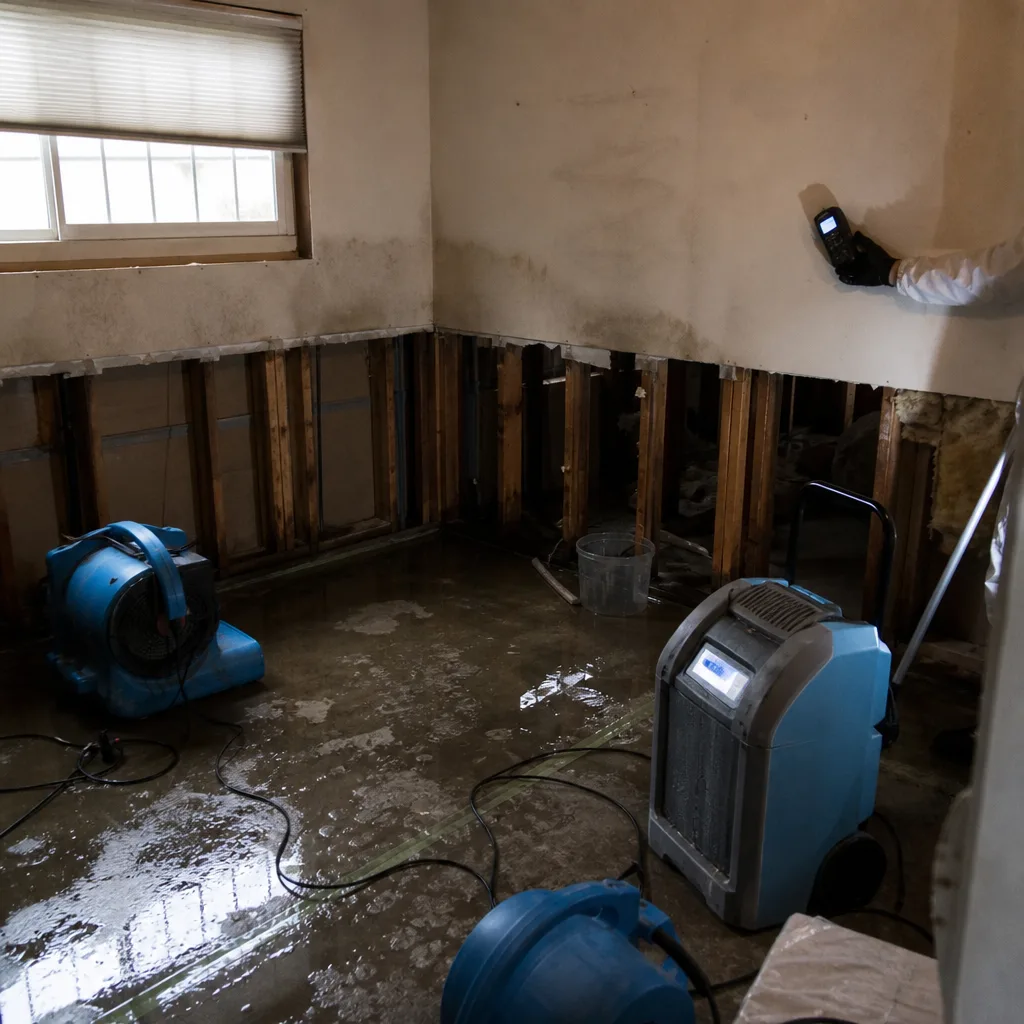 Before
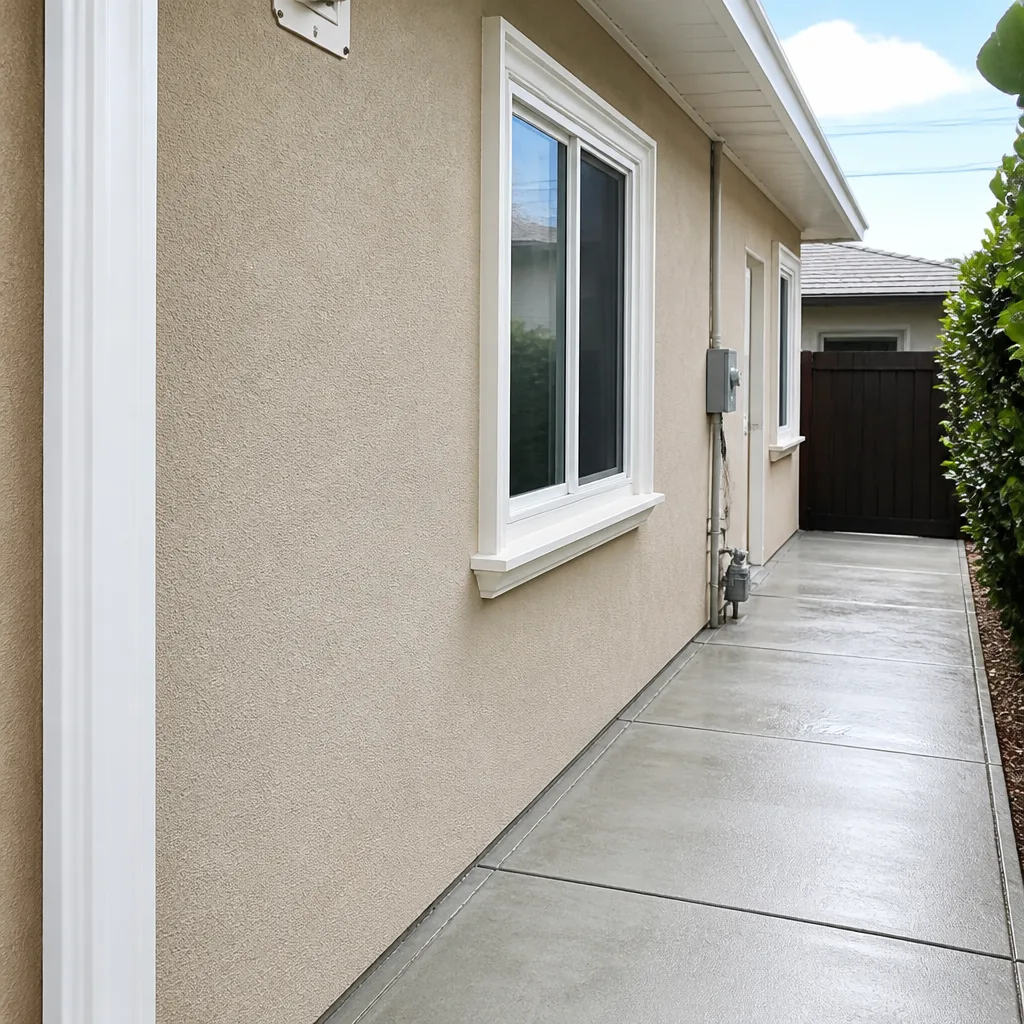 After
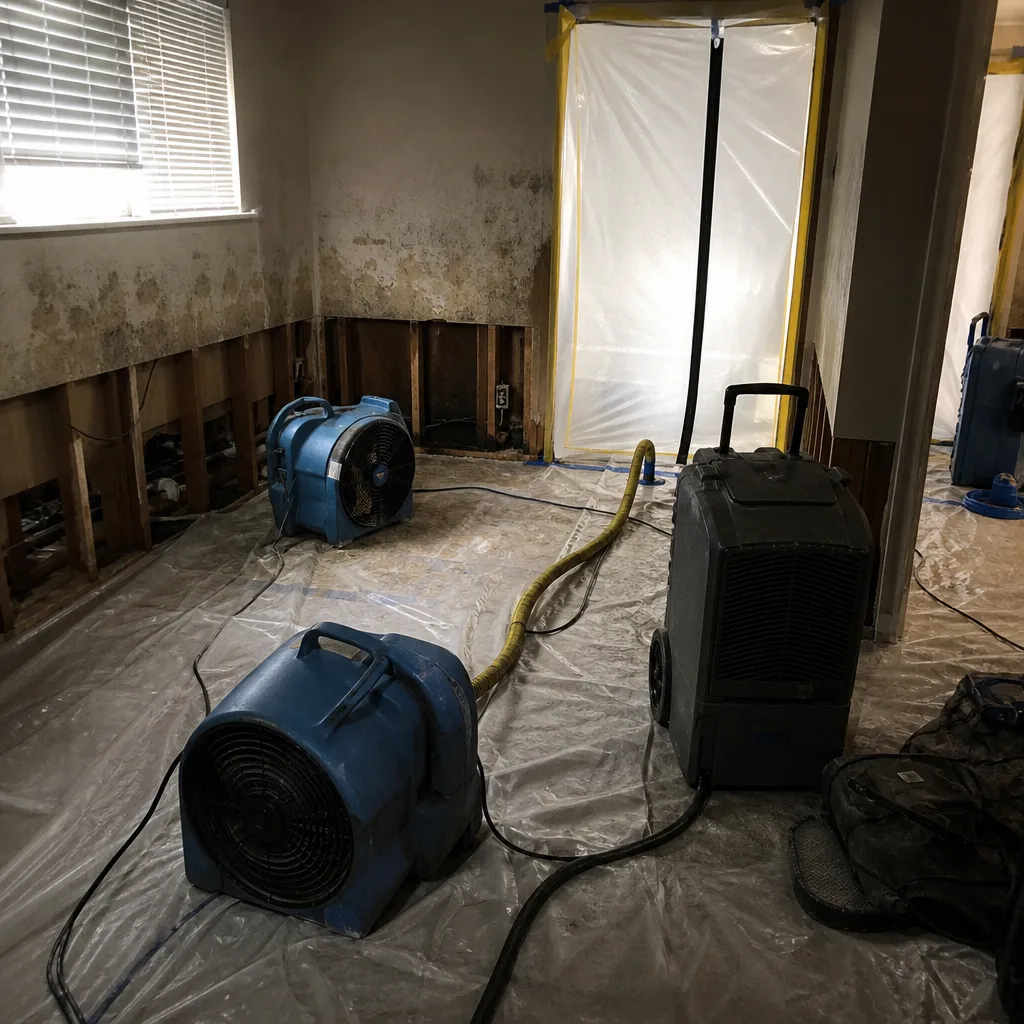 Before
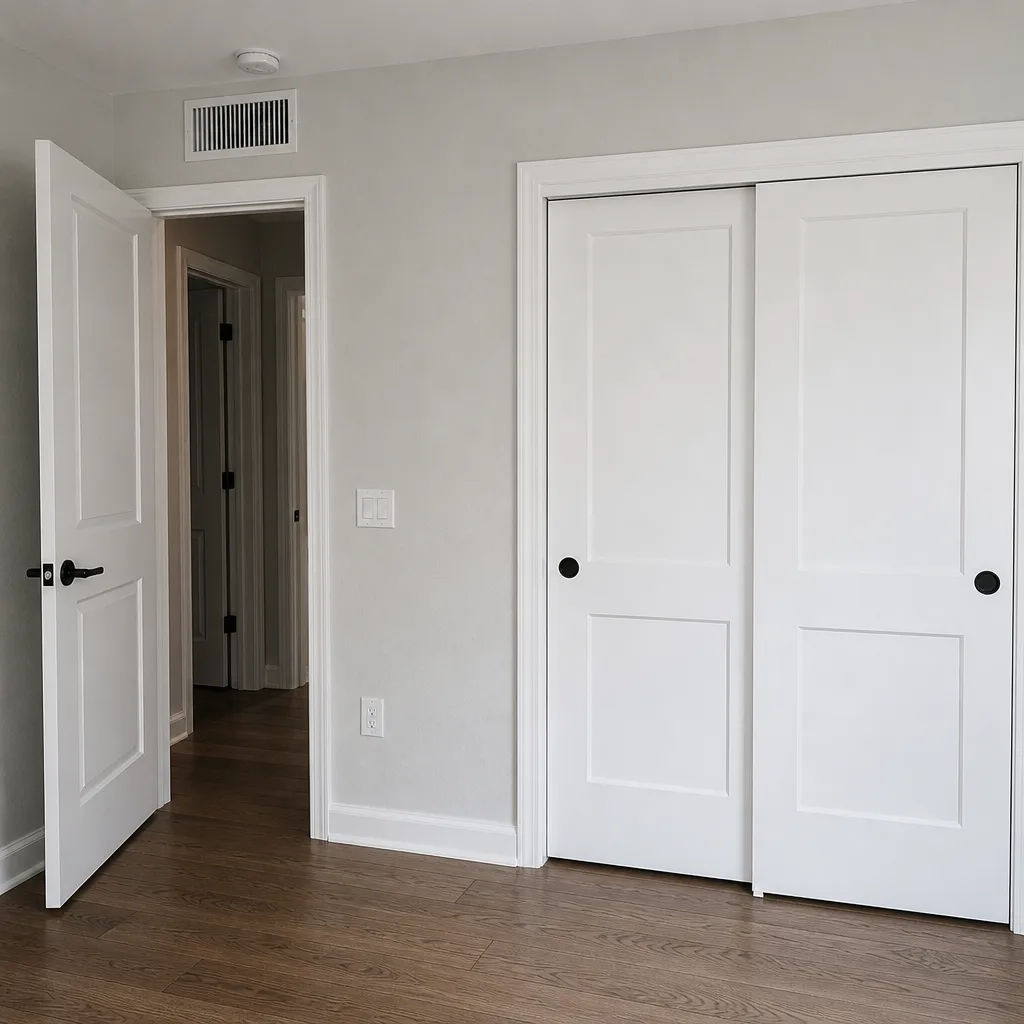 After
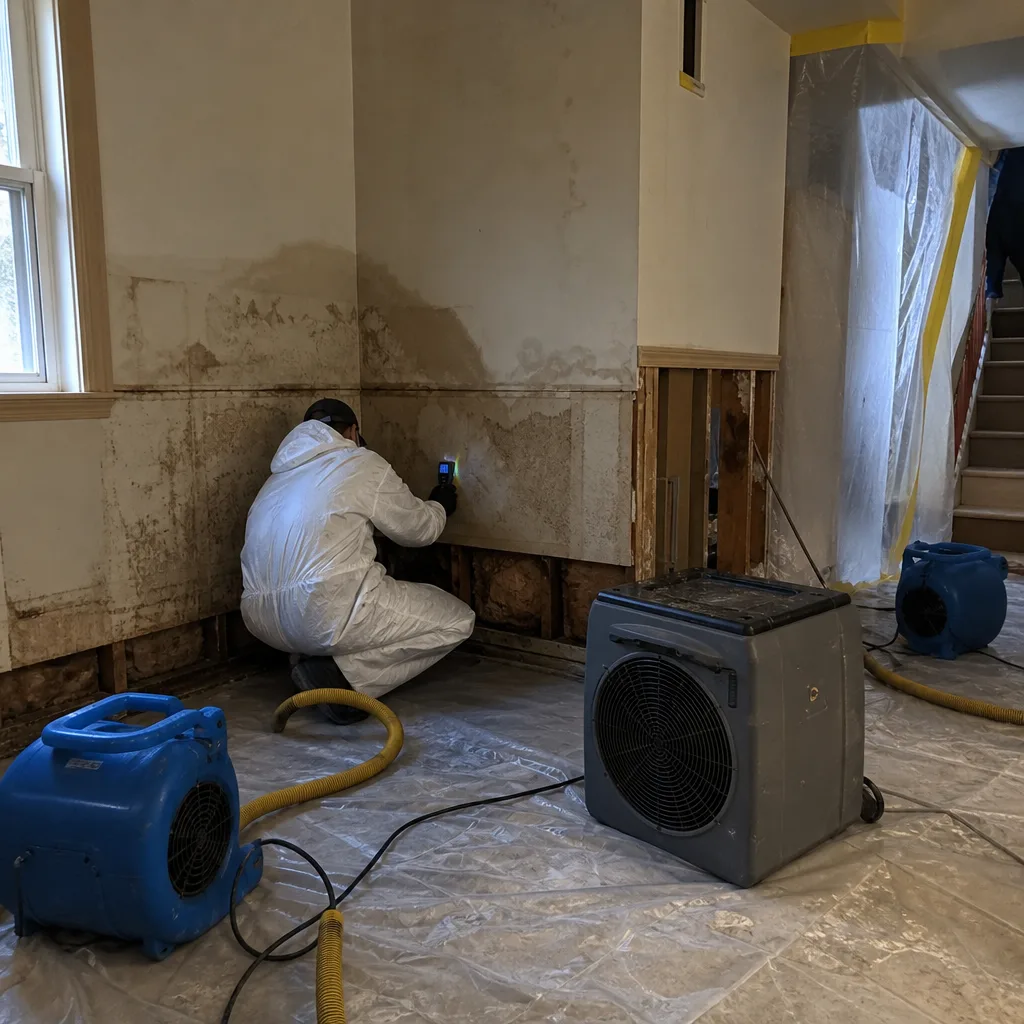 Before
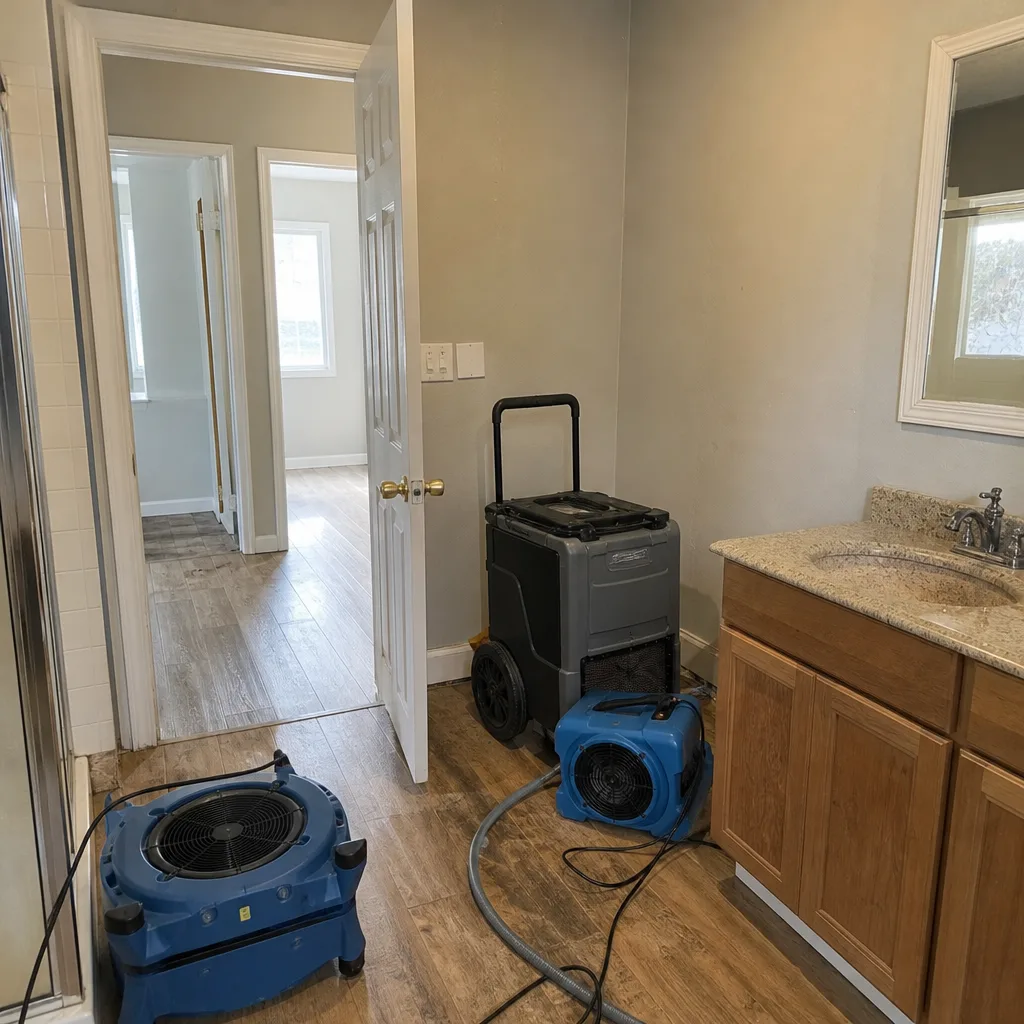 After
When to Call a Professional
Call a restoration professional when water has reached drywall, flooring, or any hidden cavity. Call when you smell musty odors that appeared after a leak. Call when a fire has left soot on surfaces beyond the immediate burn area. Call when your insurance company asks for documentation you don’t have. Call before you pull back carpet or open a wall on your own, because what you find might be Category 2 or 3, and you don’t want to spread contamination through your house without containment in place. Call when the damage is anything more than a spill you can mop up in five minutes. Mahogany Water Damage offers free estimates in Fullerton. Call (855) 356-4970 and we’ll send a certified technician to assess the scope and give you a written, itemized estimate before any work begins.
Frequently Asked Questions
Water damage restoration in Fullerton runs $3.50 to $22.00 per square foot depending on the water category, with Category 1 clean water at $3.50 to $8.00, Category 2 grey water at $5.50 to $12.00, and Category 3 sewage at $9.00 to $22.00. A typical single-room Category 1 job totals $1,200 to $3,500, while a whole-floor Category 3 job often exceeds $15,000. The exact number depends on affected square footage, materials involved, equipment deployment time, and how quickly drying started. Call (855) 356-4970 for a free written estimate in Fullerton.
Quotes vary because contractors scope work differently based on equipment, process standards, and what they’re willing to include. A contractor using rental-grade equipment and skipping containment can quote 40 percent less than a contractor running commercial Dri-Eaz systems with full IICRC protocols. The lower quote isn’t a better deal; it’s a smaller scope. The higher quote includes equipment capacity, daily monitoring, documentation, and a dry standard verification that the lower quote quietly omits. Compare line items, not bottom lines.
Most homeowner policies cover sudden and accidental water damage, including supply line breaks, water heater failures, and appliance leaks. They typically do not cover gradual leaks, neglect, or flood damage from outside water, which requires separate flood insurance. The covered amount depends on your policy limits, deductible, and the adjuster’s scope. Restoration contractors experienced with insurance documentation can help ensure the full scope gets approved, including the supplemental findings that adjusters rarely catch on first pass.
Drying typically takes three to five days for Category 1 water damage with commercial equipment, four to seven days for Category 2, and one to two weeks for Category 3. Reconstruction adds time beyond drying. Fullerton’s warm climate helps drying move faster than coastal communities, but stucco construction can slow it down because moisture trapped behind stucco needs specialized cavity drying. A contractor using Injectidry targeted drying can often save walls and floors that would otherwise require demolition and replacement, which cuts the total timeline significantly.
Mold remediation is required when visible mold is present or when moisture has been trapped in building materials for more than 48 hours. Mold spores begin germinating in that window, and once they establish, drying alone won’t solve the problem. Remediation requires containment, HEPA air scrubbing, removal of affected porous materials, antimicrobial treatment, and verification that spore counts returned to normal. If you suspect mold after a water incident in Fullerton, get it assessed before it spreads through the HVAC system. Call (855) 356-4970 for a mold assessment.
Shut off the water source if you can do so safely. Move furniture and belongings out of standing water if the water is clean. Do not use a household vacuum to remove water. Do not enter standing water if it could be contaminated or if electrical outlets are submerged. Photograph everything for documentation. If the water is from a sewage backup or outside flood, stay out of the area entirely and wait for professionals with proper protective equipment and containment. Taking photographs before anything is moved helps your insurance claim.
The Bottom Line
Restoration costs in Fullerton are predictable when you understand the structure: affected square footage, water category, material type, and equipment deployment time. For more guides & resources on protecting your home, explore our blog. The biggest cost variable you control is response speed. The second is contractor selection, and that one matters more than most homeowners realize. A contractor with commercial equipment, IICRC-certified process, and the ability to document everything for insurance will produce a lower total cost than a cheaper bid that cuts scope and leaves you with hidden damage. Restoration isn’t a commodity. It’s a process with measurable standards, and the invoice should reflect those standards in line-item detail you can verify.
Written by the team at Mahogany Water Damage, serving Fullerton since 2011.