How to Choose the Right Damage Restoration Company in Fullerton
The right damage restoration company in Fullerton is one that owns commercial-grade drying equipment, employs IICRC-certified technicians, and documents every phase of the job in writing. A company with 500 five-star reviews and one air mover per truck is less capable on a large water loss than a lesser-known firm that owns 40 LGR dehumidifiers and three certified Water Damage Restoration Technicians. Equipment capacity and crew credentials don’t show up in review scores, and in an emergency, those are the two things that determine whether your home dries correctly or grows mold inside the walls. If you’d rather skip the research and talk to someone directly, call (855) 356-4970 for a free assessment.
The Wrong Questions Most Fullerton Homeowners Ask First
When water is spreading across a kitchen floor in Fullerton at 2 a.m., most people grab their phone and ask three questions: How fast can you get here? How much do you charge? Do you have good reviews? Those aren’t unreasonable questions, but they’re the wrong starting point. They measure availability and popularity, not capability. The restoration industry has a reputation problem because emergency work attracts two very different types of companies: the equipment-forward specialists who invest in commercial drying systems, and the generalist crews who rent a few fans from Home Depot and call themselves restoration experts. Both will answer the phone quickly. Both will quote you a number. Only one will have Water Damage Restoration in Fullerton capacity measured in dehumidifier count and technician certifications, not Google stars.
We’ve walked into homes in Fullerton where a previous company had “dried” a structure with three rental air movers running for a week. The baseboards were still swollen. The drywall was soft. The homeowner had paid for drying that never happened because the equipment simply wasn’t capable of pulling moisture from wall cavities and subfloor spaces. That’s not a bad company being malicious. That’s the wrong toolset being applied to the wrong job.
The 7-Question Vetting Script for Any Restoration Call
Before a crew rolls a truck to your Fullerton home, write down these seven questions and get answers on a recorded line. Legitimate companies answer all of them without hesitation. Companies that deflect, get vague, or change the subject are telling you something important.
- Are your technicians IICRC-certified, and which specific certifications do they hold? IICRC certification means the crew has passed independent testing on water damage restoration standards. It’s the restoration industry’s most recognized independent certification body, not an internal training checklist. Ask for the specific designation: Water Damage Restoration Technician, Applied Structural Drying, or Applied Microbial Remediation Technician.
- Do you own your drying equipment or rent it per job? Companies that own Dri-Eaz, Phoenix, or XPOWER systems have invested in equipment that costs tens of thousands of dollars. They calibrate it, maintain it, and match it to the job. Rental equipment means the company may not know how to run it properly, and availability depends on what the rental counter has left.
- How many LGR dehumidifiers and air movers can you deploy to one home in the first 24 hours? Large losses in Fullerton homes with multi-level layouts routinely need 8 to 15 air movers and 3 to 6 low-grain refrigerant dehumidifiers. If the company says “we bring what’s needed,” ask for a range. Vague answers mean limited inventory.
- Will you provide a written scope of work before starting? This is the single most important question on the list. A legitimate company writes down what it will do, what it won’t do, and what it costs. Companies that want to start swinging hammers before putting anything in writing are the ones that become disputes later.
- Who handles the insurance documentation, and what exactly do you give me at job close? You’re looking for drying logs, moisture readings, photo records, and an itemized scope. If the answer is “we email you a receipt,” keep dialing.
- Does your company handle reconstruction, or do you subcontract it to a separate general contractor? There’s a big difference between a company that completes the full cycle under one license and one that hands off demolition and rebuild to a third party. We’ll get into why that matters below.
- Where is your physical office located? A real restoration company has a real address you can visit. Storm-chasing crews that surge into Southern California after heavy rain events often have an out-of-state phone number and a PO box. Ask for the address and look it up on a map while you’re on the call.
Equipment Capacity Is the Hidden Differentiator in Fullerton
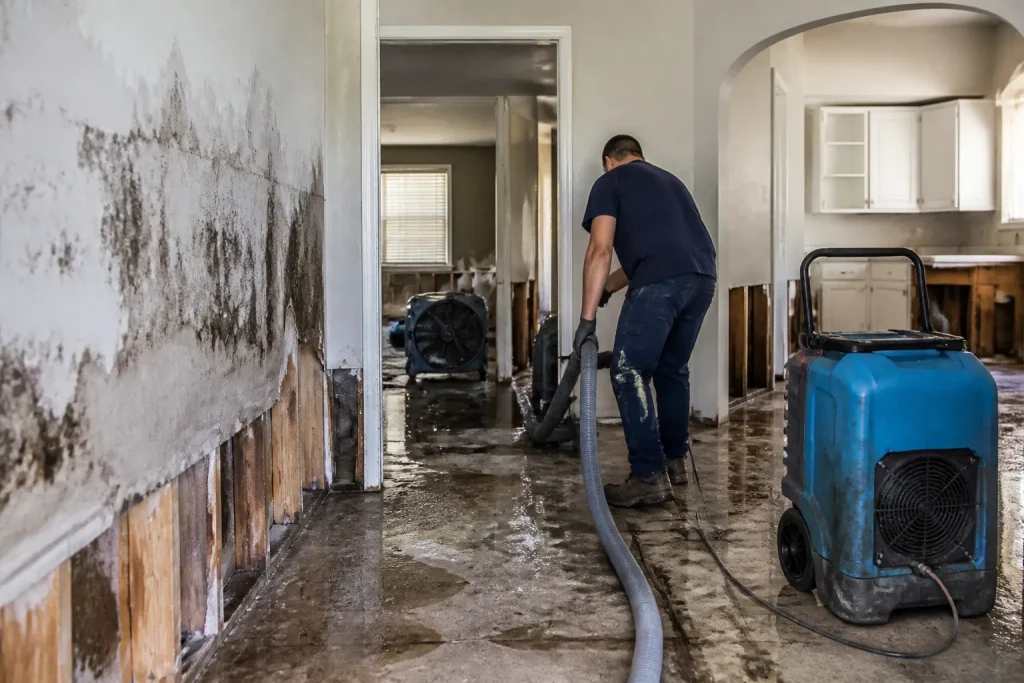
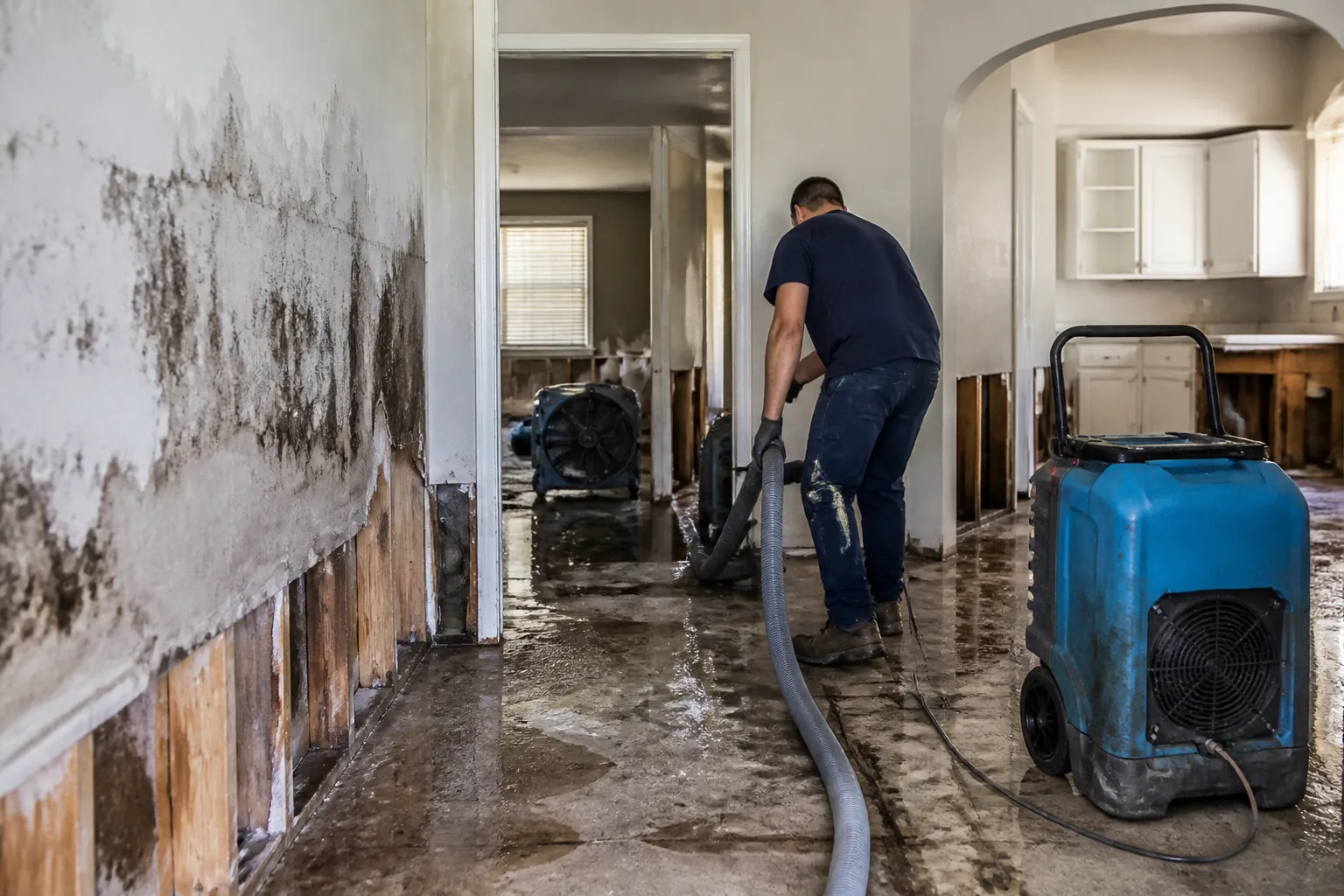
Here’s a fact most homeowners in Fullerton never learn until it’s too late: drying a water-damaged structure is a physics problem, not a cleaning problem. Water moves through building materials in predictable ways. It wicks up drywall, travels through sill plates, saturates subfloor, and settles in wall cavities. Pulling that water out requires low-grain refrigerant dehumidifiers that extract moisture from the air efficiently and air movers positioned correctly to create evaporation. A small residential job might need 4 or 5 air movers. A water heater failure that floods a garage, a hallway, and two adjacent rooms can easily need 12 to 18. Companies that own professional equipment from brands like Dri-Eaz and Phoenix keep that inventory on a shelf, ready to deploy. Companies that rent can’t always get the equipment when demand spikes after a storm event or a heat wave that drives water heater failures across Orange County. That timing matters. Every day without proper drying gives mold a longer head start.
Injectidry is another piece of the equation most homeowners have never heard of. It’s a targeted-injection drying system that forces air directly into wall cavities and under floors. The alternative is demolition: cut out the drywall, pull up the flooring, and replace it. Injectidry can save walls, floors, and cavities that would otherwise be torn out, which reduces both disruption and cost. A company that has Injectidry on hand is making a different calculation than one that reaches for a reciprocating saw. Ask if they have it. The answer tells you something about their approach.
Restoration Contractor, Public Adjuster, Remediation-Only Firm: Know the Difference
This is where Fullerton homeowners get tripped up by terminology. Three different roles get called “restoration” in casual conversation, and they do very different things.
A restoration contractor performs the actual work: water extraction, structural drying, demolition, cleaning, and often reconstruction. They’re licensed contractors who employ technicians and own equipment. This is what Mahogany Water Damage home is.
A public adjuster is a licensed insurance professional who works for you, the policyholder, to negotiate your claim with the insurance company. They don’t do any restoration work. They might recommend a contractor, but they’re a separate role with a separate fee structure, typically a percentage of the claim settlement.
A remediation-only firm handles the mitigation phase: drying out water, removing mold, cleaning after a fire. But they stop at the property line between mitigation and rebuild. That means when your drywall is removed and your floors are pulled up, you’re coordinating a second contractor for reconstruction. Two companies, two schedules, two sets of paperwork, and a handoff gap where miscommunication lives.
Why does conflating these three lead to scope gaps? Because when a remediation-only firm demos your Fullerton home and disappears, you’re left holding a dried-out shell and a list of subcontractors to call. And when a public adjuster recommends a cheap crew, they may be optimizing for claim speed, not restoration quality. Understanding who you’re actually talking to on the phone prevents all of this. The best-positioned companies handle the full damage trilogy – water, mold, and fire – under one roof. One team, start to finish. That’s not a convenience. It’s the difference between a documented, completed restoration and a construction project that stalls for three months while you play general contractor.
Red Flags: Storm Chasers and the AOB Trap in Orange County
Fullerton doesn’t get hurricanes, but it gets heavy seasonal rains, and Orange County is a target for traveling restoration crews that follow storm systems across the country. They arrive with magnetic truck signs, aggressive door-knocking tactics, and a stack of pre-printed contracts. Here are the specific warning signs:
- Out-of-state licensing or no California contractor’s license at all. Legitimate Fullerton restoration companies hold California licenses and can show you the number on request. Storm chasers often can’t.
- High-pressure signing on the spot. If a crew shows up at your door and insists you sign an Assignment of Benefits (AOB) before they’ll start work, slow down. An AOB transfers your insurance claim rights to the contractor. In some situations that’s workable, but you should never sign one under pressure, without reading it, or before you’ve verified the contractor’s credentials.
- No physical address in Fullerton or Southern California. They’ll have a phone number that rings to a call center in another state. Ask for an address. If they can’t give you one you can drive past, that’s your answer.
- They diagnose “extensive mold” from the street. Before they’ve even done a moisture inspection, they’re telling you the whole house needs treatment. A legitimate assessment requires readings, not a persuasive pitch.
The AOB deserves special attention because it’s the document where homeowners get into real trouble. Assignment of Benefits is legal in California, but the predatory version of it – the high-pressure signature, the vague scope, the contractor who inflates the claim and then disappears – is the number one way restoration disputes escalate. If someone at your door is more interested in getting your signature than in finding the water source, that’s not a restoration professional. That’s a sales operation.
What “Full-Service” Actually Means in Restoration
“Full-service” gets thrown around a lot in this industry, and most of the time it’s meaningless. Here’s what it should mean, using a full water loss in Fullerton as the example. Full-service means the same company that extracts the water also sets the drying equipment, documents the moisture readings, removes unsalvageable materials, treats for mold, and either performs or directly manages the reconstruction. Not a subcontract to a separate GC the homeowner has never met. Not a handoff to a mold remediation vendor from Riverside. One point of accountability from assessment to completion. That structure eliminates the gap where things fall through: the baseboard that doesn’t get replaced, the cabinet that wasn’t on the original scope, the drying log that never gets delivered because two companies are pointing at each other.
We handle water, Mold Remediation in Fullerton, and Fire Damage Restoration in Fullerton internally. That’s not a sales pitch. It’s a structural difference that changes how the job runs. When one company holds the entire scope, there’s one schedule, one point of contact, and one party responsible if something goes wrong. When three companies split the work, you’re the coordinator, the mediator, and the one holding the bill if something falls between the scopes.
We pulled one out of a garage over in the area near Acacia Park last month where the homeowner had already gotten two bids. One company said the whole garage wall had to come out. The other said they’d “dry it in place” with three air movers. Neither had put a moisture meter on the wall cavity. We found moisture trapped behind the drywall, set up targeted drying with an XPOWER air mover setup and a Phoenix LGR dehumidifier, and saved the wall. The homeowner kept her drywall, her insulation, and about four thousand dollars. The equipment mattered more than the pitch.
The Paperwork File: What a Legitimate Company Gives You at Job Close
When a restoration job in Fullerton is finished, you should receive a documentation file. It should include drying logs showing daily moisture readings, clearance readings confirming the structure hit drying standards, photo records from before, during, and after, an itemized scope of work, and any certificates or clearances relevant to the job, such as a mold clearance if remediation was performed. That file is worth more than any warranty card. If you sell your home in Fullerton and a buyer asks whether there was ever water damage – and they will ask – that documentation file is the difference between a smooth disclosure and a sale that stalls or falls apart. It proves the work was done to standard, not “looks good to us.”
A company that can’t or won’t produce drying logs at job close didn’t document the work because they weren’t measuring it. Moisture readings are the restoration industry’s version of a lab report. Without them, you’re taking someone’s word for the fact that your walls are dry. And take it from someone who’s seen the alternative: walls that feel dry to the touch can still be holding enough moisture to feed mold growth for months after the crew leaves. That’s why we say the endpoint of every job should be “restored to standard.” It’s measurable, documented, and verifiable. Not a vibe.
The Bottom Line
Choosing the right damage restoration company in Fullerton comes down to asking the right questions before the crew arrives. The most important information isn’t in review scores or the speed of the quote. It’s in equipment inventory, technician certifications, documentation practices, and the company’s actual Fullerton-area address. Ask the seven vetting questions on the phone. Verify the IICRC certification. Look for owned commercial-grade drying equipment from brands like Dri-Eaz and Phoenix, not rented units from the nearest big-box store. Understand whether you’re talking to a full-service restoration contractor or a remediation-only firm that will hand you off before reconstruction. And demand a written scope and a documentation file before work begins. If you’re in Fullerton and need help, Mahogany Water Damage offers free assessments and straight answers – call (855) 356-4970.
Frequently Asked Questions
How fast can a damage restoration company actually get to my Fullerton home?
A legitimate Fullerton restoration company with local crews can typically be on-site within a few hours for emergency water extraction, with full equipment deployment the same day. The first 24 to 48 hours are critical for preventing mold growth, so speed on the initial response matters. For non-emergency assessments, same-day or next-day scheduling is standard. Call (855) 356-4970 and we can tell you exactly when a crew can be at your door.
Will my insurance cover the cost of water damage restoration?
Most standard homeowners policies cover sudden and accidental water damage, such as a burst pipe or water heater failure. Gradual leaks and flood damage from external sources are commonly excluded. What matters is documentation: photos, moisture readings, and a detailed scope of work are what adjusters respond to. A full-service restoration company that coordinates directly with your adjuster removes most of the friction from the process. Ask about direct insurance billing and photo-documented assessments when you call.
Do I really need professional drying equipment, or can I just use fans from the hardware store?
You need professional drying equipment. Household fans and shop vacs move surface moisture but cannot extract water that has wicked into drywall, subfloor, and wall cavities. That’s what LGR dehumidifiers and commercial air movers are designed to do. A $200 rental fan setup is the most expensive money you’ll ever spend if mold grows behind your drywall. The physics of drying a structure don’t bend to a tight budget.
How do I know if a restoration company’s certifications are real?
Ask for the specific certification designation and then verify it with the issuing body. IICRC certifications can be checked through the IICRC’s verification system. A company that claims certification but can’t name the specific designation or is reluctant to provide verification isn’t certified. Membership in professional associations like the RIA or IFA is another signal, but it’s secondary to the actual technician-level certification. Ask the question on the phone: “Which IICRC designations do your technicians on this job hold?”
Written by the team at Mahogany Water Damage, serving Fullerton since 2011.
Need Damage Restoration Help?
Call Mahogany Water Damage — licensed & insured, here with fast after-hours help in Fullerton.
(855) 356-4970