
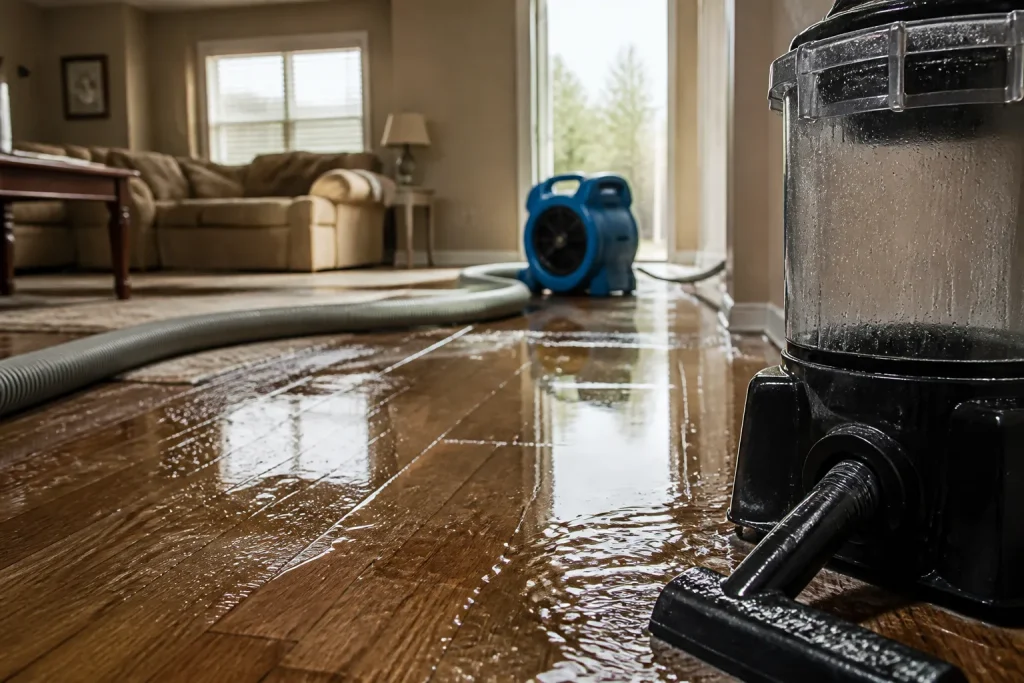
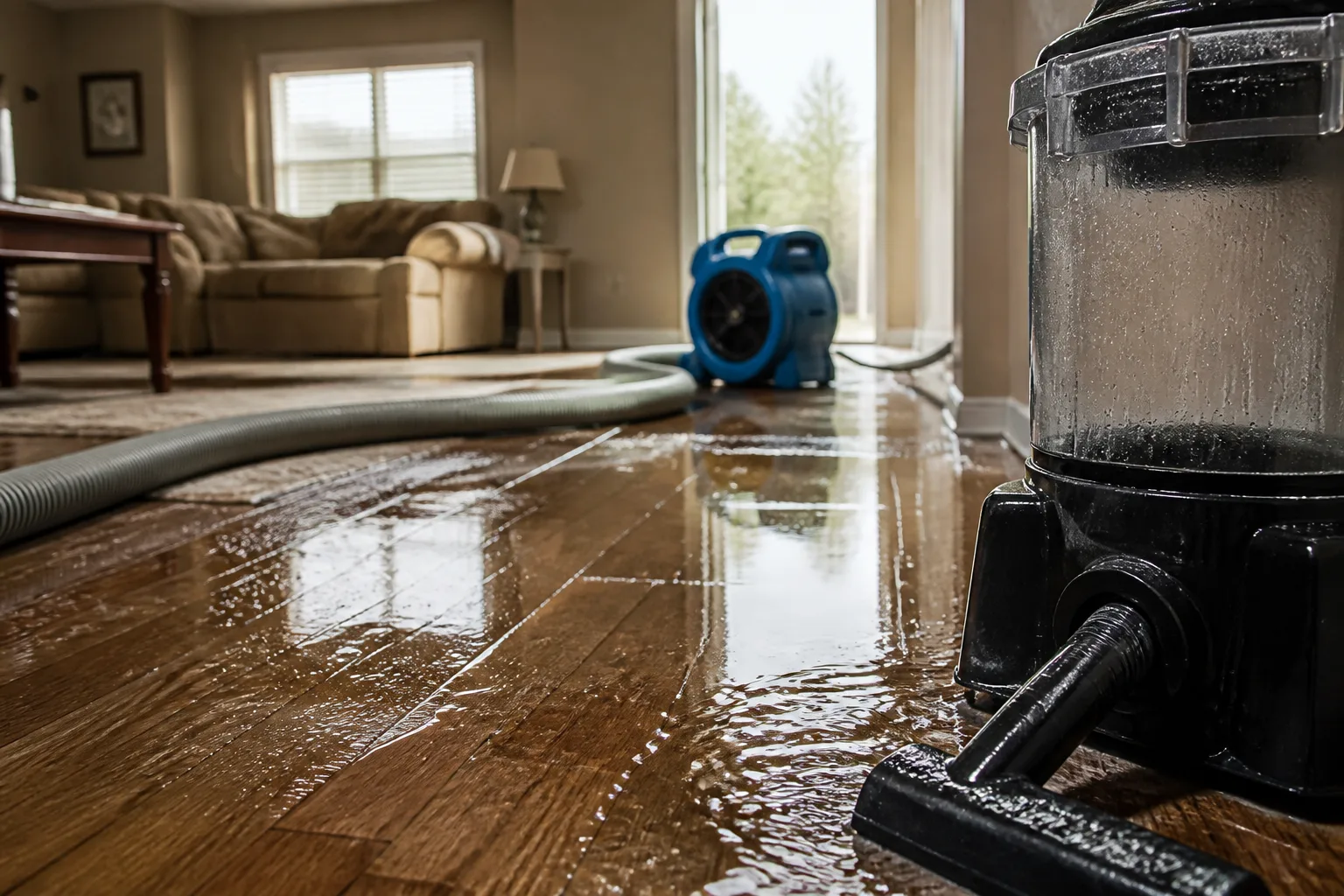
Emergency Water Damage Restoration Near Me: What Fullerton Homeowners Should Do First
If water is rising in your Fullerton home right now, shut off the water source if you can do so safely, then call (855) 356-4970. The first four hours determine whether this is a $3,000 dry-out or a $15,000 mold remediation plus rebuild. Most homeowners in Fullerton make the same three mistakes in that window: they run household fans, they wait for the insurance adjuster, and they assume wet drywall will air-dry on its own. All three make the damage worse.
We pulled a 1,200-square-foot ranch off Euclid near Hillcrest Park last February where the owner had spent the previous evening running a box fan across soaked laminate. The fan had pushed warm, wet air into the baseboards and wall cavities. What should have been a two-day dry-out turned into a wall-cavity mold job that required opening nearly every exterior wall. The box fan was the reason.
What to Do in the First 15 Minutes: Stop, Document, Decide
Your instinct will be to start grabbing towels. Put the towels down. In the first fifteen minutes, the goal is to stop the source and create a record.
First, stop the water. If the source is a ruptured supply line, shut the valve at the fixture or the main. If it’s a roof leak during a Fullerton winter storm, place a tarp or bucket and move anything salvageable. If you cannot identify the source, get a plumber and a restoration crew dispatched simultaneously and shut the main if the water is still flowing.
Second, photograph everything before you move a single item. Use your phone. Walk the perimeter of the affected area. Get wide shots of every room with standing water. Get close shots of the waterline on baseboards and drywall. Open cabinet doors and photograph the kickplates. Pull back a corner of wet carpet and photograph the pad. These photos are the baseline your insurance adjuster will compare against later, and they establish that the damage originated from the event you’re claiming, not from neglect during the mitigation period.
Third, decide whether it’s safe to stay. If water has reached any electrical outlet, light switch, or the base of an appliance, treat the affected rooms as energized and call both a restoration company and an electrician. Do not enter standing water near electrical. Do not attempt to move a refrigerator, washer, or water heater that has been sitting in water.
The 1-Hour Call: Who Should Be On-Site and What Should Arrive
By the end of the first hour, a legitimate emergency response should be on-site or in route with a defined ETA. When you call, ask three questions before hanging up:
- What equipment is on the first truck? A real water damage company’s first truck carries a truck-mounted or high-capacity portable extractor, air movers, a dehumidifier, and moisture meters. A company that shows up with a Shop-Vac and a rented carpet cleaner is not performing mitigation; they’re performing cleanup.
- What’s your response time, in writing? For a Fullerton emergency, a same-day or within-90-minutes dispatch is reasonable. If they hedge, keep calling.
- Who handles the insurance documentation? The company should be able to provide moisture maps, daily drying logs, and photo documentation formatted for adjusters. Ask directly.
Our first truck to a Fullerton emergency carries Dri-Eaz and Phoenix drying systems, not rental units. That distinction matters because the equipment is calibrated, maintained, and sized to the job before it leaves the yard. A dehumidifier that’s too small for the square footage extends drying time, and extended drying time is what opens the door to mold colonization.
While you’re waiting, do the safe, useful work: prop up furniture legs with foil or wood blocks to keep them out of wet carpet. Move small items to a dry room. Do not use household fans, do not run your central HVAC in an attempt to dry the space, and do not use a household dehumidifier as a substitute. Household units pull a fraction of the moisture a commercial unit does, and moving air without extraction pushes moisture deeper into materials.
Fullerton’s Building Stock: Slab vs. Raised Foundation Changes the Playbook
Fullerton’s housing stock is split between two foundation types, and the correct dry-out strategy depends on which one you have. Slab-on-grade homes, common in the neighborhoods south of Chapman and throughout much of the older tract development, trap moisture beneath flooring and in wall baseplates because there’s no air gap underneath. Water that seeps through vinyl plank or carpet into the slab edge wicks up into drywall and stays there because the concrete is a moisture reservoir.
Raised-foundation homes, more common in the historic neighborhoods around downtown and in hillside pockets, have a vented crawlspace that changes both the risk and the solution. Water in a raised-foundation home drains downward, but it also saturates the subfloor from below, which means extraction must happen from the crawlspace side as well as above. We use Injectidry targeted-injection drying on both foundation types: for slab homes, we inject dry air into wall cavities and behind baseboards where water hides; for raised homes, we run injection lines into the subfloor from the crawlspace to dry the underside of the flooring.
The point for a Fullerton homeowner in the first four hours: find out what’s under your floor. If you don’t know, the restoration crew should determine it before they place a single piece of equipment. Drying a slab home with a raised-foundation strategy leaves bottom plates wet and sends you into week two of a job that should have ended in four days.
When NOT to Do It Yourself: Sewage, Electrical, and Asbestos
There are three situations in Fullerton where a homeowner should do nothing except shut off the water, close the door, and wait for the restoration crew.
Sewage backup. A sewer line backup or toilet overflow involving sewage is a category 3 water loss under the IICRC standard. The water contains bacteria, viruses, and parasites. Do not attempt to extract it with household equipment. Do not let family members or pets walk through it. The affected area requires containment, removal of porous materials, and antimicrobial application under controlled conditions. This is not a bleach-and-mop situation.
Electrical proximity. If water is within three feet of an outlet, switch, electrical panel, or appliance, the room is an electrocution hazard. Wait for a professional who can verify power has been shut off to the affected circuits before extraction begins.
Suspect flooring. Homes built in Fullerton before the mid-1980s often have vinyl flooring or adhesive that contains asbestos. Disturbing that flooring while it’s wet by pulling it up, cutting it, or grinding it releases fibers into the air. A restoration company that’s certified will test before disturbing any suspect material. If a company tells you they’ll just rip it up and deal with it later, send them home.
The Insurance Myth: Waiting for the Adjuster Costs You Money
The most expensive misconception we hear in Fullerton goes like this: “I’m not touching anything until my adjuster sees it.” The homeowner then waits three days with wet drywall and saturated carpet, and then their insurer denies the mold portion of the claim because the policyholder failed to mitigate secondary damage.
Most California homeowner policies include a duty-to-mitigate clause. That means the homeowner is contractually obligated to take reasonable steps to prevent further damage once the event occurs, even before the adjuster arrives. Waiting three days with water sitting in the structure is not reasonable mitigation; it’s an invitation for the insurer to argue that mold growth was preventable and therefore excluded.
The correct sequence is: document everything yourself with your phone, call a restoration company, begin extraction and drying immediately, and have the restoration company document the entire process so the adjuster can review a complete record rather than a static scene. Insurance claims are settled on documentation. The better the documentation, the more straightforward the claim. A restoration company that photographs the waterline before extraction, logs moisture readings daily, and maps the affected zones with photos gives the adjuster everything they need to approve the claim without sending a third-party inspector.
In our experience in Fullerton, homeowners who begin mitigation within four hours have claims approved faster and with fewer disputes than those who wait. The adjuster isn’t going to demand to see the wet carpet; they’re going to demand to see proof of what was wet, for how long, and what was done about it.
What a Real 24/7 Emergency Response Looks Like
“24/7 emergency response” is printed on every water damage website in Orange County. The test is what happens when you call at 2 a.m. Here’s what to expect from a legitimate operation:
You reach a live dispatcher who collects the basics: address, water source, affected rooms, and whether it’s clean water, gray water, or sewage. They give you a response window. The first crew arrives with extraction equipment and begins pulling standing water before doing anything else. Moisture mapping starts immediately, because the water you can see is only part of the problem. Wall cavities, subfloor, baseboards, and insulation all hold water that won’t show on the surface.
Within the first 24 hours, the crew should have established a drying plan with a target number of days, placed commercial air movers and dehumidifiers sized to the affected square footage, and provided you with a written scope of work. If they can’t tell you what’s wet, what they’re doing about it, and when it will be dry, you’re dealing with a company that’s guessing.
Ask about their process. An IICRC-certified firm works to a defined standard, not an internal checklist. The drying plan should be based on moisture readings, not on “we’ll check it in a few days.” We track every job in Fullerton with daily moisture logs and adjust equipment placement based on what the meters say, not on a schedule.
When to Call a Pro
You’ve called a plumber, the water is stopped, and the affected area is one small bathroom with a damp vanity. Can you handle it yourself? If the water was clean, the affected area is under 10 square feet, no water reached the walls or flooring edges, and you have a way to verify dryness with a moisture meter, you might be able to manage it with fans and time.
If any of the following are true, call a professional in Fullerton immediately: water touched drywall or baseboards; the affected area is larger than a small rug; the water source is sewage or flood water; water has been sitting for more than a few hours; or you smell anything musty, which means mold has already begun. When in doubt, a free phone assessment costs you nothing. Call (855) 356-4970 and describe what you’re seeing; we’ll tell you honestly whether you need a full response or whether you can handle it with the equipment you already own.
For related services in Fullerton, see our Water Damage Restoration in Fullerton page for the full drying process, or Mold Remediation in Fullerton if you’re past the 48-hour mark and suspect mold has begun. If the water came with a fire, our Fire Damage Restoration in Fullerton page covers the combined response.
The Bottom Line
Water in a Fullerton home is not a wait-and-see problem. The first hour is for stopping the source and documenting everything. The second hour is for making the call. The fourth hour is when materials are either salvageable through drying or compromised enough to require tear-out and mold treatment. Run fans, wait for the adjuster, and hope for the best, and you’ll own a mold problem by the weekend. Document, extract, dry with commercial equipment, and you’re back in your house with a clean insurance claim and no secondary damage.
If you’re in Fullerton and water is where it shouldn’t be, call Mahogany Water Damage at (855) 356-4970. We’ll talk through what you’re seeing, tell you whether you need a full response, and give you a straight answer on timing. Estimates are free. The first truck carries Dri-Eaz and Phoenix drying systems, not rental units, and the crew is IICRC-certified with the process to match.
Frequently Asked Questions
A legitimate emergency restoration company in Fullerton should be on-site within 60 to 90 minutes of your call, with an extractor, air movers, and a dehumidifier on the first truck. If a company can’t give you a written response time, keep calling. For a same-day response, call (855) 356-4970 and we’ll confirm ETA before we hang up.
Yes, in most cases. California policies require the homeowner to mitigate further damage immediately, which means starting extraction and drying before the adjuster arrives. Document everything with photos, keep the restoration company’s drying logs, and provide those to the adjuster. Delaying mitigation to wait for an adjuster often voids coverage for mold and secondary damage, which can become the larger part of the claim. Call (855) 356-4970 if you’re not sure how to handle your specific policy.
If water touched drywall, baseboards, or flooring edges, household fans will push moisture deeper into wall cavities and subfloor, which accelerates mold colonization. Professional drying uses commercial dehumidifiers sized to the square footage, moisture meters to track progress, and targeted injection drying for cavities that fans can’t reach. A small contained spill on tile can air-dry; a soaked room cannot.
Touch is not a moisture test. Drywall and subfloor can feel dry to the hand while retaining enough moisture to feed mold inside the cavity. A restoration company uses moisture meters to read materials at depth and a dehumidifier placement strategy to verify the entire affected area has reached a dry standard before equipment is removed. We provide daily moisture logs on every Fullerton job so you can see the numbers dropping day by day.
Written by the team at Mahogany Water Damage, serving Fullerton since 2011.
Need Damage Restoration Help?
Call Mahogany Water Damage — licensed & insured, here with fast after-hours help in Fullerton.
(855) 356-4970